A reliable exporter must prove more than a nominal LPH rating or claims such as “100% safe” and “all feed water sources.” By checking the supplier’s legal identity, export documents, destination-market compliance, water analysis, design assumptions and test records, you can compare bids on usable output and lifecycle risk.
Key takeaways
- Verify the exporter’s company registration, tax identity, premises and responsible contacts.
- Match export documents and certifications to your destination country’s import rules.
- Demand water-analysis-based design calculations, performance tests and a commissioning plan.
- Put capacity, water quality, warranties, spares, training and remedies in the contract.
How can you verify that an RO plant exporter is a legitimate supplier?
A reliable RO plant exporter proves its company identity, premises and accountability with documents you can cross-check—not with a catalogue, website or social-media page. Use this exporter verification procedure before reviewing technical specifications.
1. Request the registered legal name, incorporation certificate, tax registration, ownership details and complete factory and service addresses. Complete factory address verification through the local company registry, map records and a live video tour or in-person inspection. Ask whether the manufacturing site is owned or leased.
2. Request the exporter’s past shipment evidence, including destination countries, export references and a sample commercial invoice, packing list and certificate of origin. Check that the legal name, address, product description and country of origin match across all three documents.
3. During the factory inspection, ask to meet the people responsible for engineering, assembly, testing, commissioning and after-sales service. A trader that cannot identify these individuals, show test equipment or explain its service structure is not equivalent to a manufacturer.
4. Contact two customers that bought comparable RO plants. Ask each about delivery accuracy, packaging condition, commissioning support, warranty response time and spare-parts availability. Speak to the customer directly using independently verified contact details.
5. Keep evidence in a supplier file: registry records, tax details, site photographs, inspection notes, export references, matched shipping documents and customer call records. Stop the evaluation if names conflict, addresses change without explanation or the exporter refuses inspection or customer contact.
Can the exporter meet the rules of your destination country?
A plant that works in its country of origin can still fail import inspection or remain unusable at your site. Put the destination-country rules into the purchase specification before fabrication, not after the skid arrives.
- Confirm destination voltage and frequency, cable-entry system, panel standard, enclosure or IP rating, and short-circuit rating.
- Specify IEC 60204-1 for machine electrical equipment and IEC 61439 for low-voltage switchgear assemblies.
- State the hazardous-area classification and required PLC/VFD settings documentation where the plant enters a classified zone.
- Request pressure-vessel drawings, material certificates, design calculations, inspection reports, test certificates and relief-device settings.
- For drinking water, define the exact scope: NSF/ANSI 58 for residential RO systems, NSF/ANSI/CAN 61 for health effects of components, or NSF/ANSI/CAN 372 for weighted-average lead content.
- Require compliant labels, manuals, customs codes, certificate of origin and ISPM 15 treatment marks on wood packaging.
For European Union shipments, CE marking is a manufacturer’s declaration, not an independent performance certificate. Obtain the CE Declaration of Conformity, applicable directives, harmonized standards, technical file and risk assessment; an unspecified “CE approved” claim proves little.
Also settle transport protection in writing: preservation duration, desiccant, lifting points, centre of gravity, vibration and corrosion protection, and container-securing responsibility. Name the party responsible for import clearance, duties, port handling and damage inspection, or a legally compliant plant can become a costly site problem.
How should you compare the plant’s design for your water and demand?
A 500 LPH label does not prove suitability. Base RO plant sizing on a recent feed-water analysis covering TDS, temperature, turbidity, pH, hardness, alkalinity, silica, barium, strontium, iron, manganese, chlorine, oil and microbiological loading.
| Water source | Design risk | Pretreatment to investigate |
|---|---|---|
| Municipal | Chlorine, turbidity or seasonal variation | Activated carbon or dechlorination; filtration |
| Borewell | Hardness, iron, manganese, silica | Softening, iron removal or antiscalant |
| Surface water | Turbidity and high biological loading | Coagulation, filtration or ultrafiltration |
| Seawater or high-TDS industrial water | High pressure, scaling and difficult reject disposal | Seawater RO, specialised antiscalant and robust pretreatment |
Polyamide membranes require control of free chlorine and other oxidants. Ask for the allowable exposure, dechlorination method, monitoring point and alarm or interlock; residual oxidant can damage membranes even when initial permeate quality looks acceptable.
Calculate permeate flow from litres required per day, daily operating hours, peak demand and storage-tank volume. Then use the recovery percentage to determine feed and reject flows; a 500 LPH plant producing only during a short shift may not meet a peak drawdown.
The quotation should state feed flow, permeate flow, reject flow, design recovery, membrane make and model, design flux, operating pressure, power supply, footprint, noise and ambient-temperature range. Require a saturation or scaling calculation naming the limiting constituent and confirming reject-disposal conditions. Higher recovery reduces waste volume but concentrates salts and raises scaling risk.
What evidence proves that the promised water quality and capacity are real?
Do not approve an RO performance guarantee from a nominal LPH figure; demand a design projection tied to your actual water. It must show feed analysis, temperature, pressure, recovery, permeate flow, salt passage and assumptions. Ask whether LPH means permeate output, feed flow or recovery-based output, and whether the comparison uses 25°C.
Temperature, TDS, pressure and fouling change capacity.
Salt rejection is not the same as permeate conductivity. Define the sampling point, temperature compensation, stabilization time, start-up diversion, and whether acceptance tests first-pass permeate or final product after blending.
| Claim | Evidence required | Risk if undefined |
|---|---|---|
| 99.9% bacteria removal | Named test method, organisms, turbidity, chlorine and microbial conditions | Unrepeatable claim |
| 100% safe | Specified contaminants and laboratory limits | No measurable acceptance standard |
| All feed water sources | Defined feed chemistry and pretreatment limits | Scaling, fouling or membrane damage |
Require feed-water analysis, guaranteed permeate analysis, membrane-element model and data sheet, calibration certificates, and commissioning results. Include these factory acceptance test checks:
- Pressure tests, pump rotation and current, valve sequencing, alarms and interlocks
- High-conductivity diversion, emergency stop and data logging
- Witnessed production at agreed temperature, pressure, recovery and feed quality
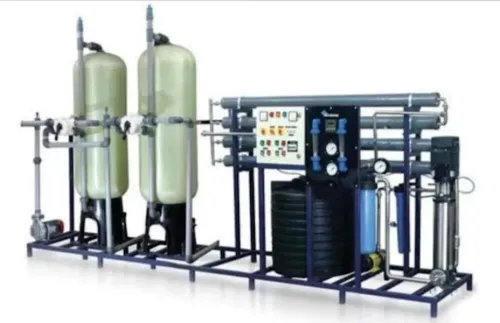
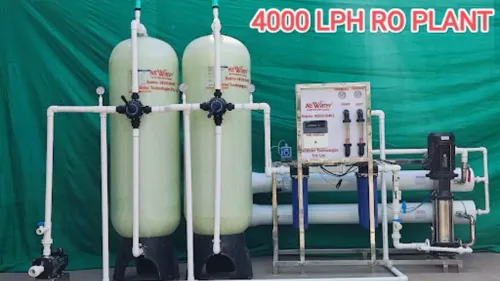
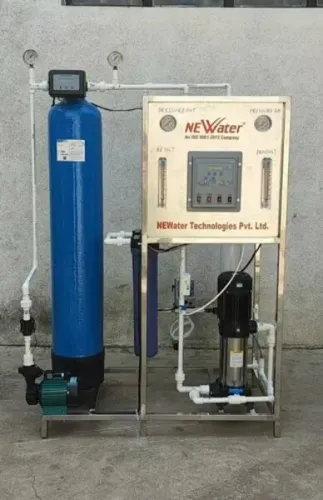
NEWater Technologies Pvt Ltd should be assessed against this evidence checklist, including installation support, rather than selected on capacity claims alone. Reject acceptance if the exporter will not record actual readings under the agreed comparison conditions.
Related product
 | Exported RO Plants newater india from rajkot View product → |
What should the contract cover beyond the purchase price?
The contract must cover performance, payment, delivery and after-sales risk—not only the equipment price. Incoterms allocate selected costs, responsibilities and risk-transfer points; they do not automatically settle title, payment security, insurance, commissioning, performance or warranty response.
Specify FAT approval, shipping documents, site acceptance, liquidated damages, operator training, commissioning duration, warranty exclusions, response times, spare-parts supply and who pays for repeat visits. Define automatic start-up diversion to drain, conductivity limits, sensor validation and actions after high conductivity, low pressure or pretreatment failure.
Obtain the exact membrane-element model, OEM data sheet, maximum feed temperature and pressure, pH range, oxidant limit, cleaning limits and replacement terms. A membrane warranty depends on these operating conditions and pretreatment, not simply on the exporter’s stated warranty.
Compare each bid using a multi-year RO plant lifecycle cost schedule:
| Cost or risk | Low-price bid | Comparable contract |
|---|---|---|
| Consumables | Price only | Cartridge filters, antiscalant, membrane elements, UV lamps, chemicals and seals |
| Reliability | Unpriced downtime | Dosing pumps, sensors, critical spares, labour and repeat visits |
| Utilities | Equipment only | Electricity and reject-water disposal |
| Support | Remote promise | Response times, local stock, preservation, shutdown and cleaning procedures |
Require preservation duration, desiccant, lifting points, centre of gravity and container-securing duties. Also state cleaning frequency, local stock arrangements and remote support. This exposes when a cheap plant creates higher consumable costs or downtime after shipment.
Frequently asked questions
How can you verify that an RO plant exporter is a legitimate supplier?
Cross-check the exporter’s company registration, tax identification, registered address, factory or office premises, bank-account name and named project contacts. Ask for documents you can verify through official registries or independent site checks.
Can the exporter meet the rules of your destination country?
Give the exporter your destination, intended use, electrical standard, import classification and required permits. Confirm the equipment’s documentation, materials, labelling, certificates and electrical components match the rules enforced in that country.
How should you compare the plant’s design for your water and demand?
Compare designs using your laboratory water analysis, feed-flow and recovery calculations, daily operating hours, peak demand, pretreatment stages, membrane selection, reject-water plan and automation requirements.
What evidence proves that the promised water quality and capacity are real?
Request design calculations, membrane projections, a factory acceptance test or performance test protocol, calibrated instrument records, commissioning results and defined sampling methods for permeate quality and flow.
What should the contract cover beyond the purchase price?
Specify the scope, water-quality and capacity guarantees, delivery terms, installation, commissioning, training, spare parts, consumables, warranty limits, response times, documentation, payment milestones and remedies for missed performance.