A plant rated at 1,000 or 2,000 litres per hour is not necessarily delivering that volume to your process. You will be able to calculate usable output, set recovery around feed-water chemistry, specify meaningful controls and compare automation choices against operator skill, maintenance needs and failure risk.
Key takeaways
- Sequence startup only after feed supply, pretreatment and concentrate flow are confirmed.
- Calculate usable capacity from demand, recovery, operating hours and planned downtime.
- Match pretreatment and RO settings to measured feed-water chemistry.
- Record pressure, flow, conductivity and alarms to detect efficiency losses early.
How automation controls the RO process, not just the workforce
Automation improves RO efficiency by sequencing water, pressure and product quality, not merely replacing an operator. Automatic start and stop can begin only when feed-tank level control confirms supply, pretreatment is ready and the concentrate path is open.
Startup uses low-pressure flushing and controlled pressure ramping; abrupt pressurisation can telescope elements, damage seals or force the pump against a closed path.
| Operating stage | Automatic function | Efficiency or protection gained |
|---|---|---|
| Startup and restart | Flush at low pressure, ramp pressure, then divert permeate on conductivity | Prevents hydraulic shock and keeps transient high-conductivity water out of the product tank |
| Normal production | Adjust pump speed with a variable-frequency drive and hold recovery, concentrate flow and permeate conductivity within setpoints | Reduces throttling losses without disguising scaling risk; recovery still must match feed chemistry |
| Pretreatment | Start backwash from differential pressure and elapsed time, with high-pressure or low-flow interlocks | Responds to sudden solids loading without wasting water through timer-only cycles |
| Fault or shortage | High-pressure protection, low-pressure protection, alarm logging and staged shutdown stop the pump, close valves and preserve restart conditions | Limits membrane, seal and pump damage |
Do not assume every automatic feature saves energy. Energy recovery equipment earns its complexity mainly in seawater RO; in brackish or low-pressure service, pressure loss, maintenance and extra controls can outweigh the benefit. Base that decision on measured pressure, flow and operating hours.
A conductivity alarm, low-flow trip or tank-full signal should stop production safely rather than send an unverified batch onward.
Calculate usable capacity from demand, recovery and downtime
A 1,000 LPH RO plant does not deliver 1,000 litres of usable water every hour. Size it from hourly demand, peak consumption, planned operating hours and downtime, then check whether storage volume covers the gaps.
Use this calculation:
Required permeate rate = daily demand ÷ available production hours
Available hours exclude membrane cleaning, pretreatment backwash, shift change and planned maintenance. For 12,000 litres per day, 16 scheduled hours and 2 hours of planned downtime, the plant must produce 857 LPH during its 14 available hours.
At 75% RO recovery, inlet flow must be 1,143 LPH: 857 litres becomes permeate and 286 litres becomes reject.
Peak consumption changes the storage answer, not always the RO nameplate. If users draw 1,500 litres in one hour, a 1,000-litre tank cannot cover that peak; install more production capacity or increase storage volume before the peak begins.
| Sizing basis | What it means | Result |
|---|---|---|
| Nameplate flow | Maximum stated permeate rate under specified test conditions | Can understate downtime and feed-water losses |
| Usable production | Permeate after cleaning, backwash and maintenance interruptions | Best basis for daily capacity |
| Storage-backed production | Lower RO output balanced by a tank during peak demand | Works when tank recovery and hygiene are controlled |
Confirm that concentrate disposal can accept the reject flow. Higher RO recovery reduces reject volume but raises concentrate salinity, scaling risk and disposal difficulty. A fixed 75% assumption is unsafe without saturation calculations.
Match pretreatment and operating settings to feed-water chemistry
Test the water before choosing the membrane or setting recovery. Measure conductivity or TDS, pH, temperature, alkalinity, hardness, calcium, magnesium, sulfate, silica, iron, manganese, turbidity, SDI15, organic matter and microbiological activity. Measure free chlorine at the RO inlet; polyamide membranes require dechlorination because oxidant exposure causes permanent salt-rejection loss.
Test or condition the feed against these decisions:
| Test or condition | Effect on design or operation | Control response |
|---|---|---|
| Conductivity and temperature | Set membrane type, pressure and expected permeate flow | Correct performance for temperature; do not compare raw flow |
| Hardness, alkalinity, sulfate and silica | Determine scaling risk and maximum recovery | Dose antiscalant, soften, acidify or reduce recovery |
| SDI15, turbidity, iron and aluminum | Predict particulate fouling and pressure-drop increase | Filter, coagulate or improve clarification; target SDI15 of 5 or lower |
| Free chlorine and organics | Threaten membrane oxidation or fouling | Dechlorinate and verify residual at the membrane inlet |
| pH and microbiology | Affect rejection, scaling and biofouling | Adjust pH, sanitize compatible equipment and control stagnation |
Set recovery from the concentrate saturation calculation, not from the pump’s rated pressure. Higher recovery raises concentrate salinity and osmotic pressure, which can reduce permeate flow and increase scaling; maintain the specified concentrate flow and keep the pump within its stable operating range.
Evaluate the plant using normalized permeate flow, normalized salt passage and pressure drop. Temperature, feed pressure, conductivity and recovery must be recorded with each reading, or a healthy membrane can look faulty while a fouling membrane looks normal.
Use measured performance data to prevent avoidable efficiency losses
A 10% decline in normalized permeate flow is a signal to investigate before production becomes unreliable. Also investigate a 5–10% rise in normalized salt passage or a 10–15% rise in pressure drop. Confirm calibration, temperature, feed pressure, feed conductivity and recovery first; an instrument error or changed operating condition can imitate membrane fouling.
Record these values under comparable operating conditions:
- Normalized permeate flow: shows whether fouling, scaling or compaction is reducing output after temperature and pressure correction.
- Normalized salt passage: shows whether rejection is deteriorating, even when raw permeate conductivity appears acceptable.
- Pressure drop: compare feed-to-concentrate pressure across the membrane vessels to detect blockage or increasing flow resistance.
- Recovery and concentrate flow: reveal whether higher recovery is increasing concentrate salinity, osmotic pressure or scaling risk.
Trigger membrane cleaning after confirming one of these trends, rather than waiting for a major production loss. Identify the foulant from feed history and differential-pressure behaviour, then choose the cleaning chemistry and sequence accordingly; cleaning a severely fouled membrane is less effective.
Use a variable-frequency drive to reduce throttling losses and hold target flux as temperature or feed conditions change. Keep the pump above its stable-flow range, because low speed can cause vibration and poor control.
Select an energy recovery device mainly for high-pressure seawater RO; in low-pressure service, compare measured pressure, flow, operating hours, added maintenance and pressure losses. Flow-pace antiscalant dosing and interlock it with confirmed feed flow.
Choose the right automation level and specify the control-panel record
Choose automation by the cost of an error, not by the number of buttons on the panel. Compare how much operator time each mode consumes, how quickly it detects a dry-run or blocked concentrate line, and whether your maintenance skill can diagnose sensors, valves, drives and PLC faults.
| Option | Operator time | Fault response | Maintenance skill | Best fit |
|---|---|---|---|---|
| Fully automatic | Low during normal running; scheduled checks remain | Automatic interlocks, alarm handling, flushing and shutdown | Electrical and instrumentation competence required | Continuous production with costly interruptions |
| Semi-automatic | Moderate; operators initiate some sequences | Alarms assist, but people complete recovery steps | Strong process knowledge and basic controls skill | Regular daytime operation with trained staff |
| Manual | High; every valve, pump and reading needs attention | Depends on operator noticing pressure, flow or level changes | Experienced operator required on every shift | Small, intermittent plants where labour is available |
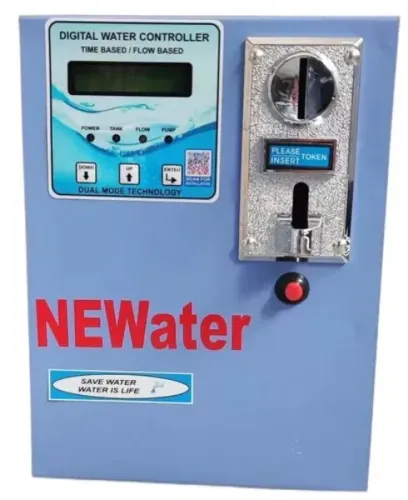
Require the control panel to record timestamped start and stop events, operating mode, feed, concentrate and permeate pressure, flows, conductivity, tank levels, pump status, chemical dosing, flush cycles, trips, acknowledged alarms and alarm history. Specify data export, not only a display; a fault that disappears after a reset cannot support diagnosis.
At commissioning, test low-pressure flushing, pressure ramping, high-pressure and low-flow interlocks, concentrate-valve protection, level control and automatic restart logic. Ask NEWater Technologies Pvt Ltd to document each tested setpoint, trip value and expected operator response in the commissioning record.
Related products
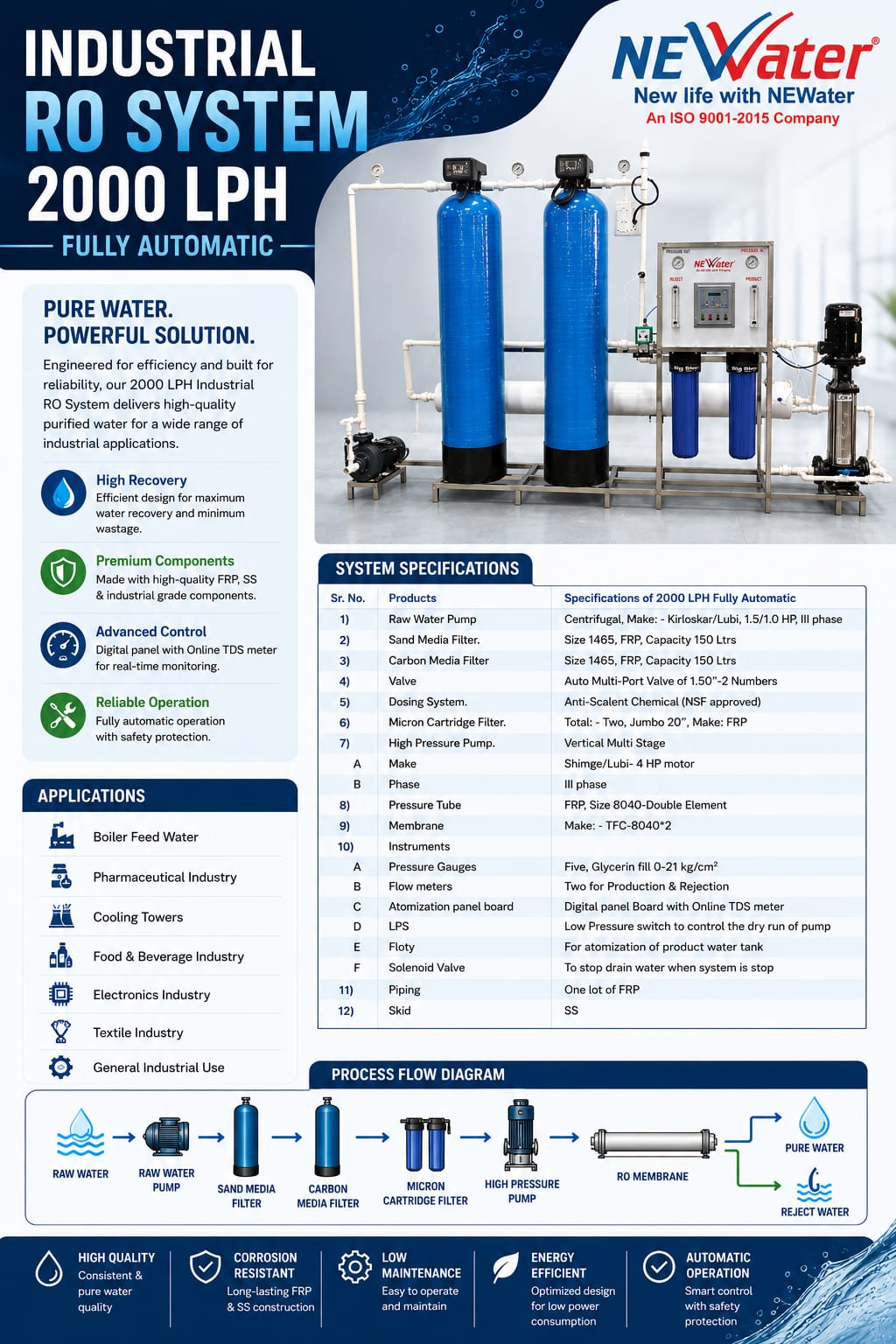 | Industrial RO Plant ₹225000 The NEWater 2000 LPH Fully Automatic Industrial RO Plant is an advanced reverse osmosis purification system engineered for reliable, continuous... View product → |
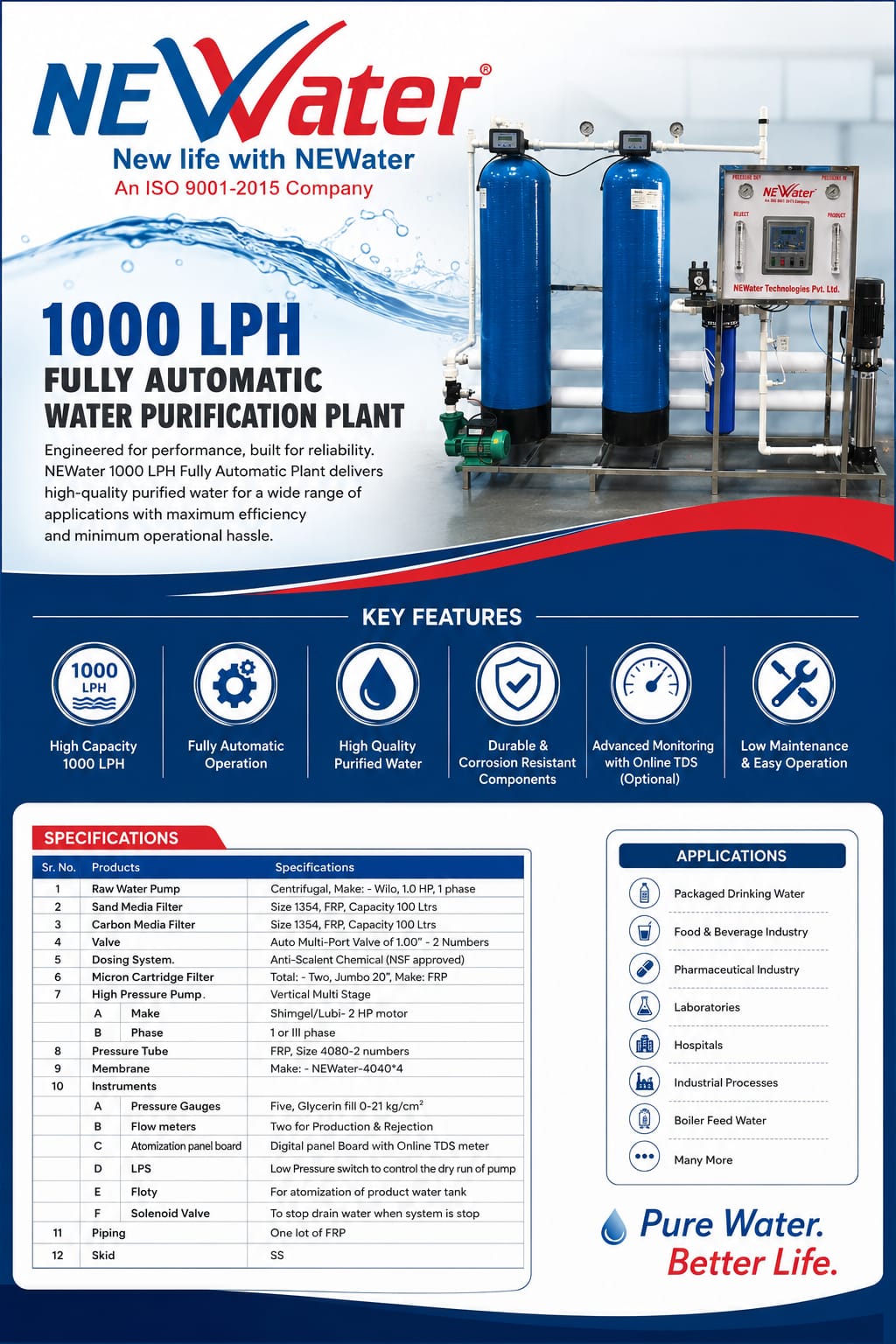 | Industrial RO Plant ₹139909 Product Description The NEWater 1000 LPH Fully Automatic Industrial RO Plant is an advanced reverse osmosis water purification system engineered to... View product → |
Frequently asked questions
How does automation control an industrial RO process?
Automation sequences feed supply, pretreatment readiness, pressure, concentrate flow, product quality checks, startup and shutdown. It does more than replace manual operator tasks.
How do you calculate usable capacity for an industrial RO plant?
Start with demand, then account for recovery, operating hours and planned downtime. Usable output is lower than the membrane nameplate capacity when the plant operates intermittently or loses time to cleaning and maintenance.
Which feed-water measurements determine pretreatment and RO settings?
Use feed-water chemistry such as turbidity, hardness, alkalinity, iron, manganese, silica, total dissolved solids, temperature and chlorine. These measurements guide filtration, antiscalant dosing, dechlorination and operating pressure.
What performance data should an automated RO control panel record?
Record feed, permeate and concentrate flow; pressure at key points; conductivity; tank levels; pump status; chemical dosing; alarms; runtime; cleaning events; and shutdown causes.
Related product
 | FRP RO PLANT 500 LPH Fully Automatic RO Plant Are you in need of a high-quality industrial RO Plant for your business? Look no further, as we are a leading manufacturer of industrial RO Plants... View product → |