Hard water leaves calcium-carbonate deposits in heaters, heat exchangers, fixtures and process lines, but an impulse conditioner does not remove the calcium or magnesium causing that hardness. By the end, you will know what the device changes, where it belongs, how to size and test it, and when a softener, reverse-osmosis plant or other treatment is the better choice.
Key takeaways
- Treat impulse conditioning as scale control, not hardness removal.
- Size the unit for peak flow and the actual pipe diameter.
- Test untreated and treated surfaces before claiming performance.
- Reject systems without installation limits, maintenance steps and test evidence.
What changes when water passes through an impulse conditioner?
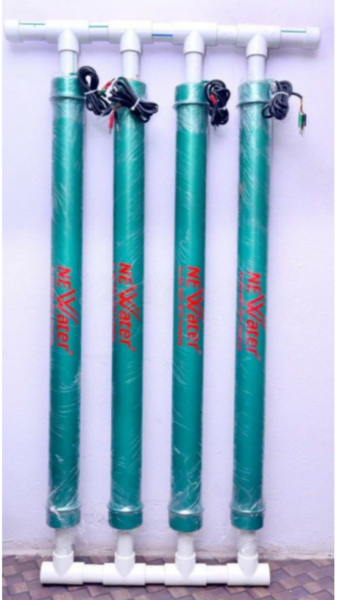
The impulse water conditioner operating principle is physical signalling, not ion exchange. A manufacturer applies a signal around or along the pipe; its conductor arrangement, electrical input and waveform are product-specific. The signal can influence how calcium carbonate crystals form, where they precipitate and how strongly they adhere to surfaces.
That is scale control versus hardness removal. The device does not remove calcium and magnesium ions. Unless it includes another treatment stage, total hardness and TDS, along with alkalinity and conductivity, remain substantially unchanged. The hardness load still enters a heater, boiler, membrane, humidifier or process line.
| Treatment | What changes | Practical result |
|---|---|---|
| Impulse conditioner | Crystal formation, precipitation location or adhesion tendency | Possible reduced deposition under specified water chemistry and operating conditions; no softer soap feel, lower spotting, sodium reduction or lower TDS |
| Cation-exchange softener | Calcium and magnesium exchange onto resin | Hardness reduction evaluated under NSF/ANSI 44; requires resin, regeneration and a discharge route |
Specify a defensible claim: reduced adhesion or deposition under named conditions, not hardness removal or universal scale prevention. A conditioner will not disinfect water or reliably control silica. Choose a cation-exchange softener when you need low-hardness water, and verify its capacity rather than treating a scale-control claim as a softener rating.
Where should the conditioner be installed and how should you size it?
Install at the incoming main when you want building-wide protection, but only if the conditioner flow rate covers peak simultaneous demand. Put it before a water heater, boiler feed, heat exchanger, or other asset when only that equipment needs treatment; use a branch for one appliance or process line.
1. Measure peak flow rather than relying on daily average consumption. Record fixture count, pipe diameter, daily volume, hardness in mg/L as CaCO3, temperature, and pressure.
2. Require the supplier to state minimum and maximum flow, pipe-size connections, allowable operating pressure, water-temperature limit, installation orientation, pressure loss, and electrical-power requirements.
3. For an externally powered design, confirm conductor placement, pipe material, power supply, grounding, environmental rating, and electromagnetic compatibility. Do not assume performance transfers unchanged between metal and plastic piping.
4. Provide bypass and isolation valves, unions, inspection access, and compatibility with meters and backflow preventers.
5. Ask whether the model suits municipal, borewell, treated, and recirculating water, and whether hot-water installation is permitted.
Do not install the conditioner after deposits have formed and expect it to remove them. A building-entry model does not automatically suit every branch, pipe geometry, flow rate, or temperature; undersizing can leave downstream equipment exposed during high demand.
Which water conditions and applications determine whether it is suitable?
Suitability depends on water chemistry and equipment duty, not simply on whether the source is borewell water or municipal water. Request a raw-water report showing:
- Calcium hardness, alkalinity, pH and temperature
- Conductivity or TDS, silica, iron and manganese
- Suspended solids and microbiological results
Scale-control performance changes with saturation conditions, flow rate, residence time, pipe material and the protected equipment’s temperature profile. A result from one test loop does not prove performance at another site.
An impulse conditioner does not disinfect water, remove pathogens or lead, lower chloride or sulfate, or reliably control silica. Install a sediment filter or strainer upstream when suspended solids could foul equipment, and provide a flush point where loose crystalline material could collect.
For drinking water, verify applicable wetted-material certifications, including NSF/ANSI/CAN 61 and NSF/ANSI 372 where relevant. These certifications address material safety, not scale-control performance.
Boilers, steam generators, humidifiers, reverse-osmosis and nanofiltration systems, and high-recovery cooling towers need chemistry control based on recovery and concentration factor.
| Option | Choose it when | What it does not provide |
|---|---|---|
| Impulse conditioner | You need deposition control | Low hardness or low TDS |
| Ion exchange | You need low hardness | Low dissolved solids |
| Reverse osmosis | You need low dissolved solids | A substitute for pretreatment |
| Antiscalant dosing or descaling | Membrane chemistry requires dosing, or deposits already exist | Universal protection |
Choose ion exchange for hardness removal, reverse osmosis for dissolved-solids reduction, antiscalant dosing for membrane requirements, and descaling service for existing deposits.
How do you install, maintain and verify scale-control performance?
Install and verify an impulse conditioner through a documented baseline, controlled commissioning and scheduled inspection—not a quick visual check.
1. Before commissioning, record hardness in mg/L as CaCO3, alkalinity, pH, conductivity, temperature, pressure, flow and the protected heater or heat exchanger’s condition. Photograph existing deposits and, where practical, measure or weigh them before cleaning. The conditioner will not remove old scale.
2. Follow the manufacturer’s instructions for conductor placement, orientation, power, grounding, pipe material and electrical safety. Confirm actual peak flow and operating temperature after installation. Keep a bypass valve available, inspect the pre-filter and strainer, and check for leaks and electrical faults.
3. Record service dates, cleaning, replacement parts and consumables. Retain strainers and provide a flush point where loose crystalline material could collect; reduced adhesion does not guarantee zero downstream deposits.
4. Use before-and-after hardness testing and conductivity testing to show that water chemistry remains substantially unchanged. Those results cannot prove scale control.
For a procurement trial, run treated and untreated control lines using the same water, flow and temperature. Define the exposure period and scale-control acceptance criteria before starting, then measure deposited mass, deposit thickness, pressure-drop increase or heat-transfer deterioration.
Inspect heating elements and record service intervals on a fixed schedule; a short coupon inspection cannot establish heat-exchanger protection. Set a quantitative threshold, such as a specified percentage reduction in deposit mass under named chemistry and operating conditions.
What should you compare before approving a conditioner?
Approve an impulse conditioner only after comparing it with the failure you need to fix: new deposit adhesion, measured hardness, low-conductivity feed, existing scale or microbial risk. The impulse conditioner procurement checklist should include this comparison:
| Option | Best fit | Salt, wastewater and electricity | Replacement, regeneration and dosing |
|---|---|---|---|
| Impulse conditioner | New deposit adhesion | No salt or wastewater; power depends on design | No resin or membrane; no regeneration; no chemical dosing |
| Ion-exchange softener | Hardness removal and softer water | Salt and wastewater; control power required | Resin replacement; regeneration; brine dosing |
| Reverse osmosis | Low-conductivity feed | No salt; reject wastewater; pump power | Membrane replacement; no regeneration; pretreatment chemicals may apply |
| Antiscalant dosing | Membrane or process scale control | No salt; little wastewater; dosing-pump power | Chemical replenishment and calibration |
| Mechanical descaling | Existing deposits | No salt; wastewater from cleaning; power depends on tools | No resin or membrane; cleaning chemicals may apply |
Ask for a datasheet stating flow range, connection size, pressure and temperature limits, power requirements, compatible pipe materials, service interval, warranty, response time and replacement parts. Require every scale-reduction percentage to name calcium hardness, alkalinity, pH, temperature, flow, pipe material, equipment type and measurement basis.
During the site survey, NEWater Technologies Pvt Ltd should create site survey records covering the raw-water report, peak flow, pipe size, pressure, temperature, protected equipment, existing deposits, bypass location and maintenance access.
Require a written commissioning record and a field trial with an untreated control. Reject the conditioner where you need hardness removal, low conductivity, certified boiler feed, reliable silica control or protection under untested chemistry.
Related product
 | Water Conditioner Brand : NEWater View product → |
Frequently asked questions
What changes when water passes through an impulse conditioner?
A signal acts around or along the pipe to influence calcium carbonate crystal formation, precipitation and surface adhesion. It does not remove dissolved calcium or magnesium by ion exchange.
Where should an impulse conditioner be installed?
Install it on the specified pipe section, following the manufacturer’s direction on flow, conductor placement, straight runs, nearby fittings and electrical access.
How should you size an impulse water conditioner?
Match the model to the pipe material and diameter, peak flow rate, operating pressure and the manufacturer’s stated treatment capacity.
Which water conditions determine whether an impulse conditioner is suitable?
Check hardness, alkalinity, pH, temperature, suspended solids, iron, manganese, disinfectant levels and the application’s scale risk before approval.
How do you verify scale-control performance?
Record baseline water chemistry, inspect or weigh scale on defined surfaces, compare treated and untreated conditions, and repeat measurements at agreed intervals.