A growing business can outgrow municipal supply, tanker deliveries or a small domestic purifier before it notices the hidden cost: interrupted operations, inconsistent water quality and expensive emergency purchases. By the end, you will be able to size an RO system from real demand, test whether RO fits your water and calculate whether onsite production beats your current supply.
Key takeaways
- Size RO output from peak-hour demand, then add 20% to 30% design margin.
- Use storage tanks to handle demand spikes without oversizing the RO unit.
- Test feed water before selecting membranes, pretreatment and final treatment stages.
- Include maintenance, energy, concentrate disposal and future expansion in the purchase case.
Choose Capacity From Demand, Not the Nameplate
Commercial RO capacity selection starts with peak-hour demand, not the number printed on the machine. Use this LPH calculation: daily water consumption ÷ planned operating hours × 1.2 to 1.3 for fouling, colder feedwater, cleaning and growth. Then check whether storage covers short, heavy-use periods while the RO unit runs steadily.
| Capacity | Approximate output in 8 operating hours | Suitable starting point |
|---|---|---|
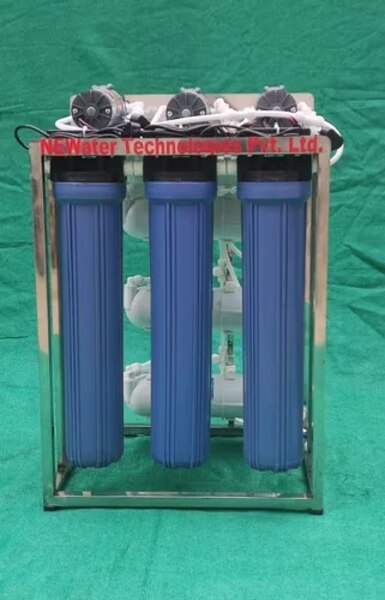
| 50 LPH | 400 litres | Small office, clinic or low-volume pantry |
| 100 LPH | 800 litres | Small commercial site with modest daily use |
| 250 LPH | 2,000 litres | Restaurant, school or light process demand |
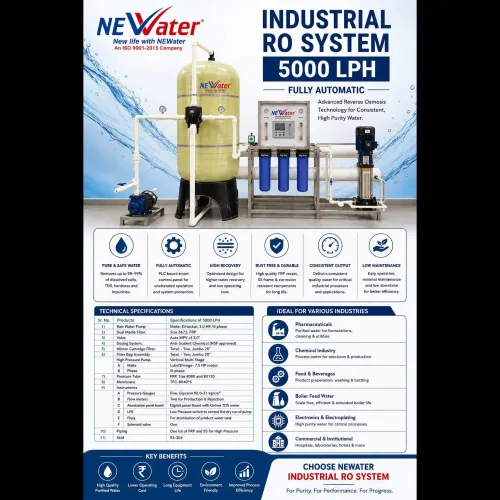
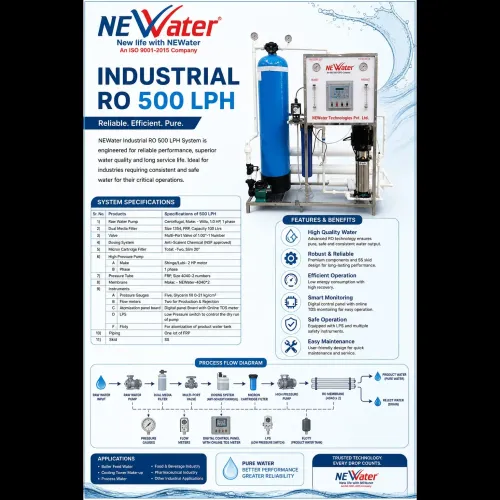
| 500 LPH | 4,000 litres | Larger institution or regular production use |
| 2,000 LPH | 16,000 litres | High-volume manufacturing or multi-shift operations |
These figures are planning outputs, not guaranteed delivery under every feed condition. A 250 LPH unit running eight hours produces 2,000 litres per day, but it will not meet a 600-litre sanitation demand concentrated into one hour unless a tank supplies the shortfall.
Measure actual daily water consumption for at least a week, identify the busiest hour, and record how long the RO unit can operate without disrupting production.
Choose 50, 100, 250, 500 or 2000 LPH only after sizing the storage tank, allowing for cleaning downtime and confirming that one train can cover demand while another is offline.
Turn Rated RO Output Into Usable Water Supply
A 500 LPH label does not guarantee 500 litres of usable water every hour. It describes nominal permeate output at stated feed-water temperature, salinity, pressure and recovery conditions.
Ask whether the rating is based on 25°C water; colder feed reduces membrane flow, so the actual permeate output can fall during winter or in a cold process area.
Before comparing quotations, check:
- Rated flow at the specified feed temperature
- RO operating pressure and required inlet pressure
- RO recovery rate
- Feed conductivity or TDS used for the test
- Number of membranes and the condition of the new membranes
Recovery determines how much feedwater becomes product. At 75% recovery, producing 1,000 litres of permeate consumes about 1,333 litres of feedwater and creates about 333 litres of reject water. At 50% recovery, the same output consumes 2,000 litres and produces 1,000 litres of reject water.
Pressure is not universal. Brackish-water systems commonly run around 10–25 bar, while seawater systems commonly need about 55 bar or more. Using seawater pressure as the basis for softened municipal water can overstate the pump size and electricity cost.
Use normalized permeate flow for planning and compare it with storage volume and peak demand. Track feed, permeate and concentrate flow, conductivity, temperature and pressure; a falling normalized flow signals fouling or scaling before the nameplate rating becomes meaningless.
Test the Feed Water and Match Treatment to the End Use
RO is suitable when RO feed-water testing shows dissolved salts or contaminants exceed the end-use specification and pretreatment can protect the membranes. Test TDS and hardness with pH, temperature, turbidity, SDI15, free chlorine, iron, silica and conductivity; TDS alone cannot reveal scaling or chlorine damage.
| End use | Required outcome | Treatment decision |
|---|---|---|
| Drinking water | Safe, palatable water | Add carbon filtration, post-disinfection and, where needed, remineralization, pH adjustment or blending |
| Process water | A defined conductivity or contaminant limit | Select RO recovery and polishing stages against the process specification, not the lowest possible TDS |
| High-hardness feed | Controlled scaling risk | Add softening or antiscalant before the membrane and verify the concentrate-disposal plan |
Specify RO pretreatment from the test results:
- Use multimedia or sediment filtration for suspended solids.
- Remove chlorine with activated carbon or chemical dosing when the membrane is chlorine-sensitive.
- Control hardness, silica and iron before they form deposits.
- Target SDI15 below 5 for many brackish-water RO applications.
Check permeate conductivity, pH and microbiological quality after commissioning. Drinking water may need remineralization because low-alkalinity permeate can attack plumbing; process water may need ultraviolet treatment, polishing or no post-treatment at all. NSF/ANSI 58 certification supports drinking-water safety claims, but it does not replace site-specific sizing, pretreatment design or process validation.
Calculate the Business Case Before You Buy
Use the same unit for every option: cost per litre of usable water. For an RO plant, divide annual ownership and operating costs by annual permeate delivered, not by the membrane’s nameplate flow.
| Option | Include in the comparison | Main risk |
|---|---|---|
| Purchased water | Tanker or bottled-water price, delivery, storage, handling and quality checks | Delivery delays and inconsistent quality |
| Smaller RO unit | Purchase, installation, electricity, filters, chemicals, cleaning, labour, sanitation and replacement membranes | Insufficient output during peaks or cleaning |
| Commercial RO plant | Equipment, installation, instrumentation, pretreatment, storage, standby capacity, concentrate disposal and downtime | Higher upfront cost and permitting effort |
Calculate commercial RO cost by adding feedwater, electricity, pretreatment chemicals, cartridge filters, membrane replacement, cleaning, labour, testing, sanitation and reject-water charges. Add the cost of lost production during service and the capital cost of standby capacity; a cheap skid becomes expensive if low recovery creates excessive concentrate or frequent cleaning stops output.
Ask NEWater Technologies Pvt Ltd, or any supplier, to quote permeate output normalized to your feedwater temperature and pressure. A rating based on 25°C can overstate winter production because colder water reduces flow.
Your cost per litre is total annual cost divided by usable litres produced. The RO payback period is installed cost divided by annual savings against your current supply. Include storage, peak demand and one train offline for cleaning before claiming water treatment ROI.
Check concentrate-disposal approval separately; sewer limits on flow, pH, temperature, TDS or chlorides can change the calculation. Compare NSF/ANSI 58 certification as a safety and claim reference, not as proof of process suitability.
Related products
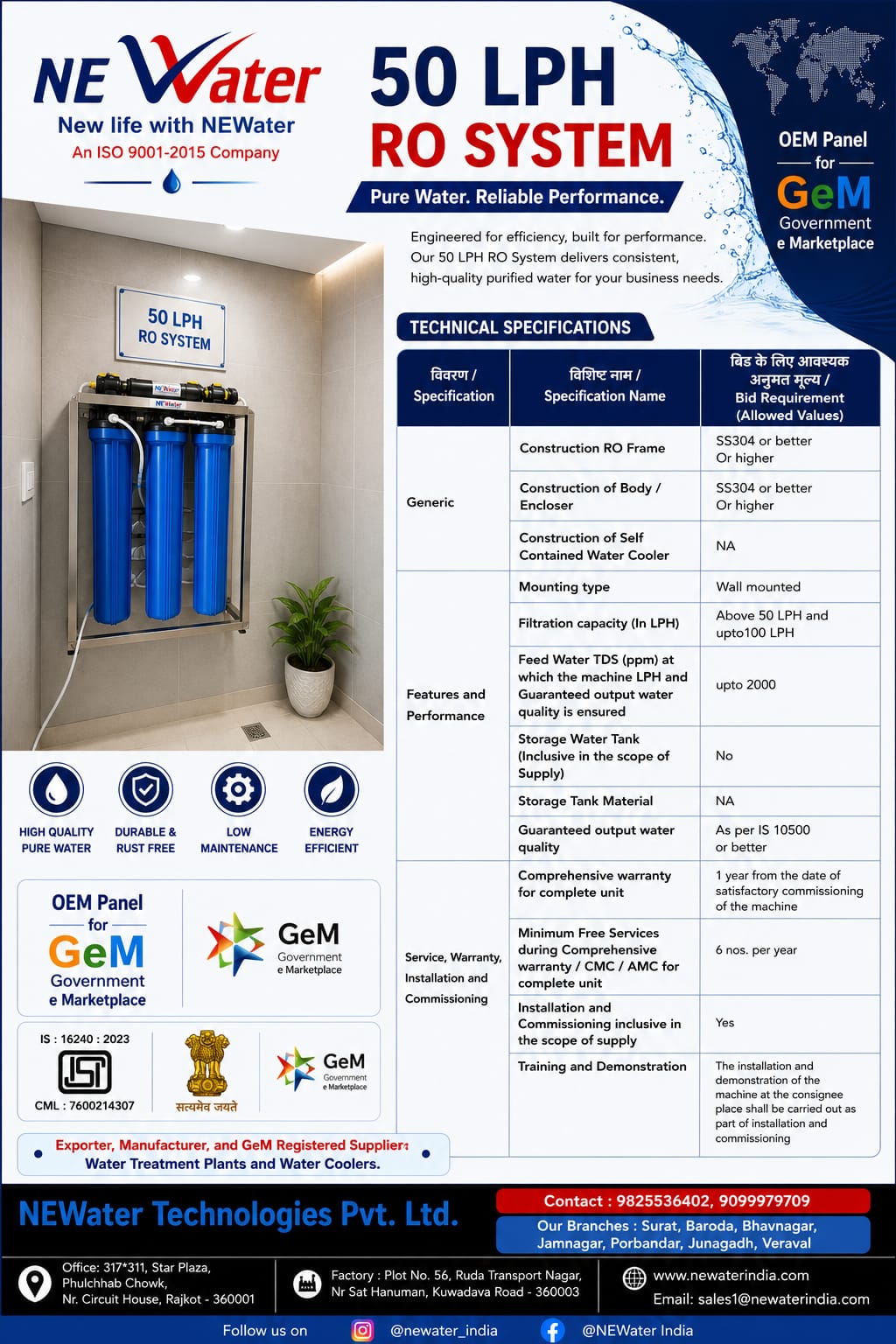 | Domestic RO System ₹18000 The NEWater 50 LPH Commercial RO System is an efficient, compact water purification solution designed for small commercial establishments, offices,... View product → |
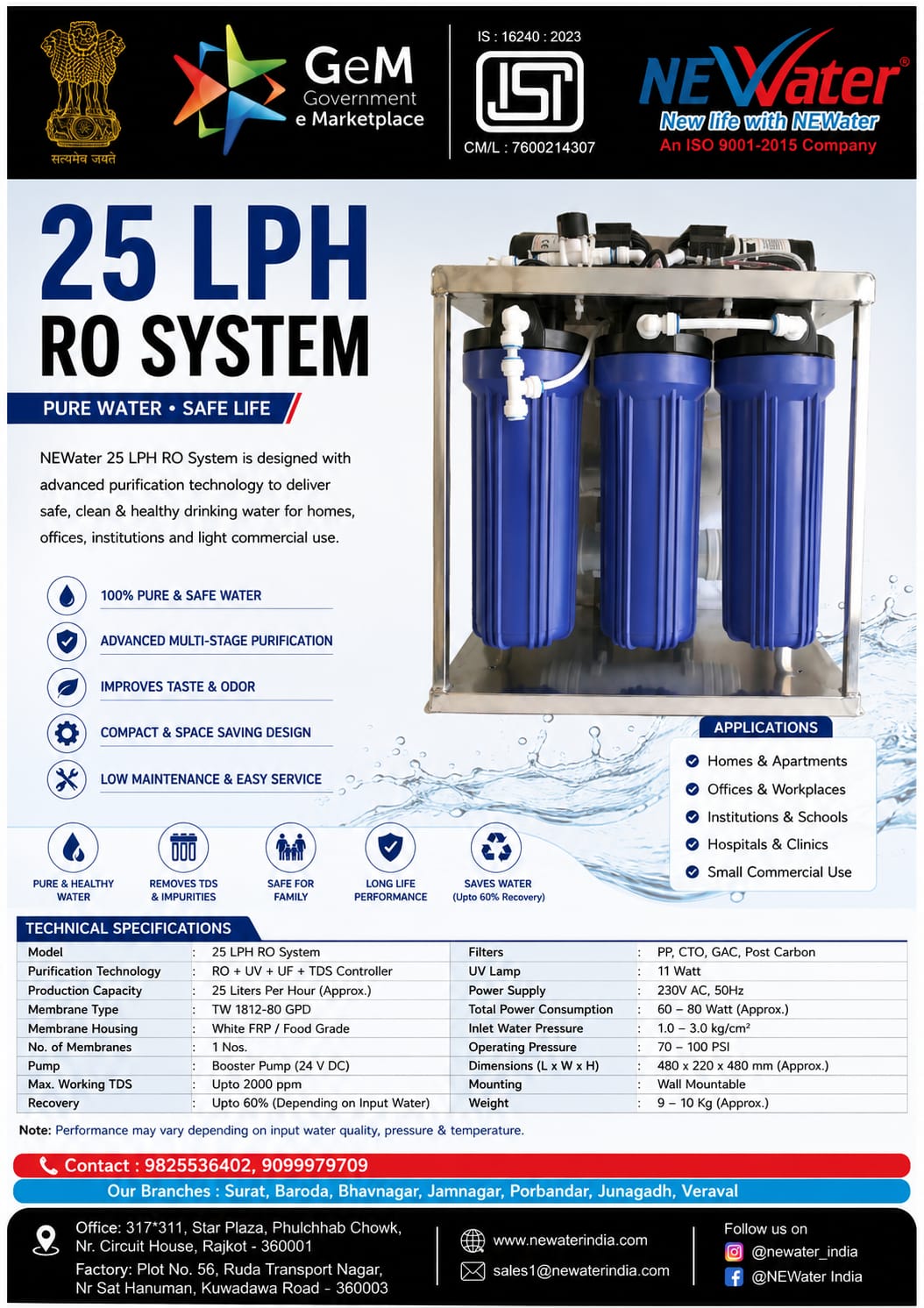 | Domestic RO System ₹9500 The NEWater 25 LPH Commercial RO System is a compact, high-efficiency water purification solution designed for small offices, clinics, cafes, retail... View product → |
Build for Growth, Monitoring and Concentrate Disposal
A membrane train sized for average demand will not cover a sanitation cycle, seasonal peak or planned cleaning shutdown. Keep peak-hour demand separate from daily volume, then use storage or parallel trains to bridge the gap.
A redundant RO system prevents one service event from stopping production, while modular skids let you add capacity without replacing the whole plant.
Your operating log should capture:
- Feed, permeate and concentrate conductivity
- Pressure before and after pretreatment and the membrane array
- Feed, permeate and concentrate flow
- Feed temperature and pH
- Free chlorine, hardness, silica and iron when they threaten membrane performance
- Silt Density Index when suspended solids could cause fouling
Conductivity alone cannot diagnose a problem. A rising value can reflect fouling, membrane oxidation, a damaged seal or inadequate pretreatment, so trend pressure, flow and conductivity together. Schedule RO maintenance around those trends rather than waiting for low production.
RO concentrate disposal can become the expansion bottleneck. Confirm the sewer’s permitted flow, pH, temperature, total dissolved solids, chlorides and metals before ordering a larger unit. If sewer discharge is unavailable, compare hauling, evaporation, deep-well injection and zero-liquid-discharge systems; permitting and disposal charges belong in the cost model.
Higher recovery also concentrates scale-forming salts, so a target such as 75% recovery demands stronger antiscalant and pretreatment design than 50%.
Frequently asked questions
How do you calculate the required commercial RO capacity?
Divide daily water consumption by planned operating hours, then multiply by 1.2 to 1.3. Check storage capacity against short periods of heavy use.
Why is a commercial RO system’s rated LPH output not the same as usable supply?
Rated output does not represent every litre available for use. Account for operating hours, recovery, cleaning downtime, fouling, colder feedwater and storage requirements.
What water tests should you complete before buying an RO system?
Test the feed water for total dissolved solids, hardness, iron, manganese, silica, turbidity, pH and microbiological contamination. Match the treatment stages to the end use.
What costs belong in a commercial RO business case?
Include equipment, installation, pretreatment, electricity, replacement membranes, cleaning chemicals, operator time, maintenance, downtime and concentrate disposal.
How should a business plan for growth when buying an RO system?
Choose controls that track pressure, flow, conductivity and recovery, and leave space for additional membranes, pretreatment or storage as demand increases.
Related products
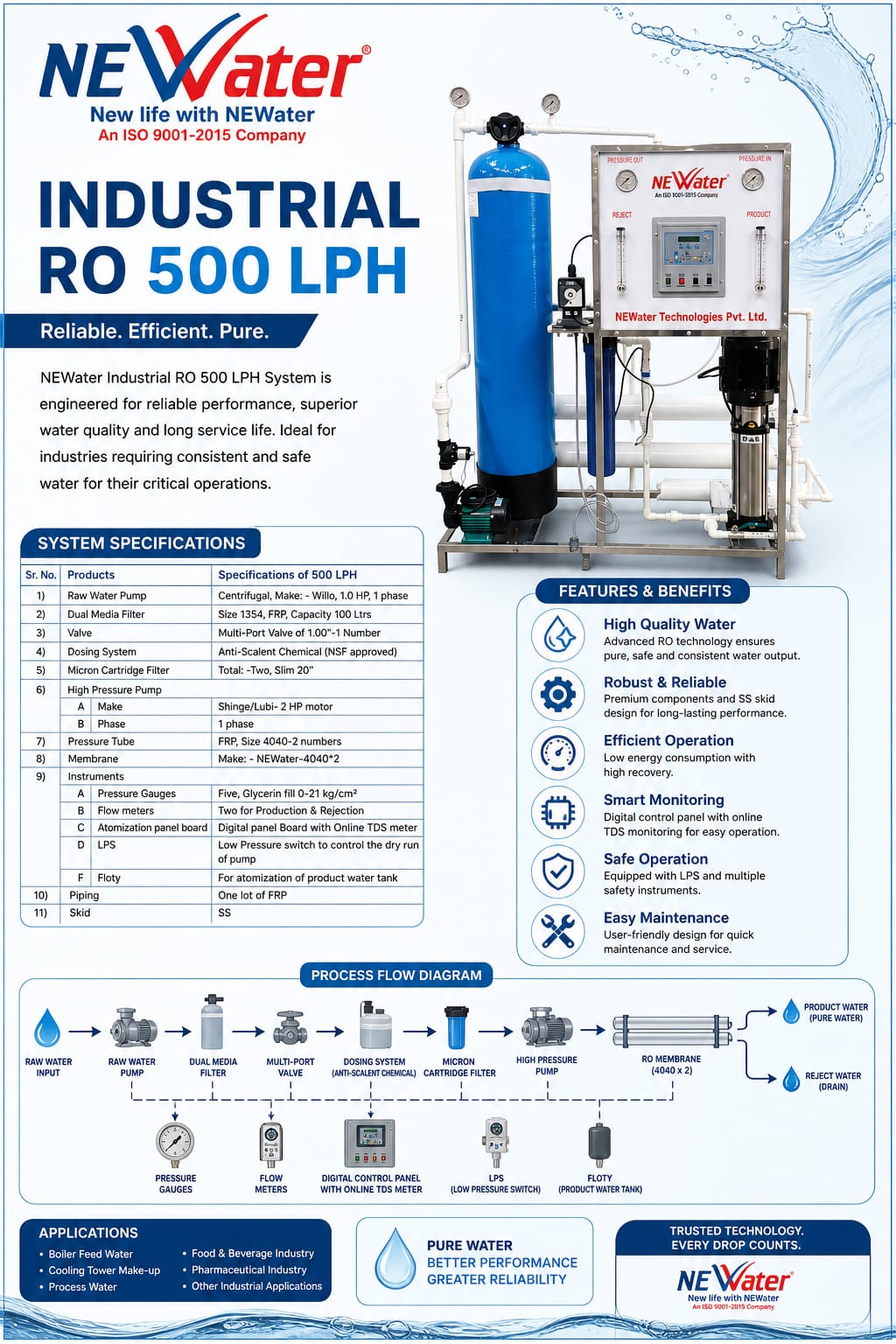 | Industrial RO Plant ₹90000 Product Description (under 2,000 characters) The NEWater 500 LPH Semi-Automatic Industrial RO Plant is engineered to deliver reliable,... View product → |
 | FRP RO PLANT 500 LPH Fully Automatic RO Plant Are you in need of a high-quality industrial RO Plant for your business? Look no further, as we are a leading manufacturer of industrial RO Plants... View product → |
 | Commercial RO Plants manufacturer Please contact us for more information View product → |
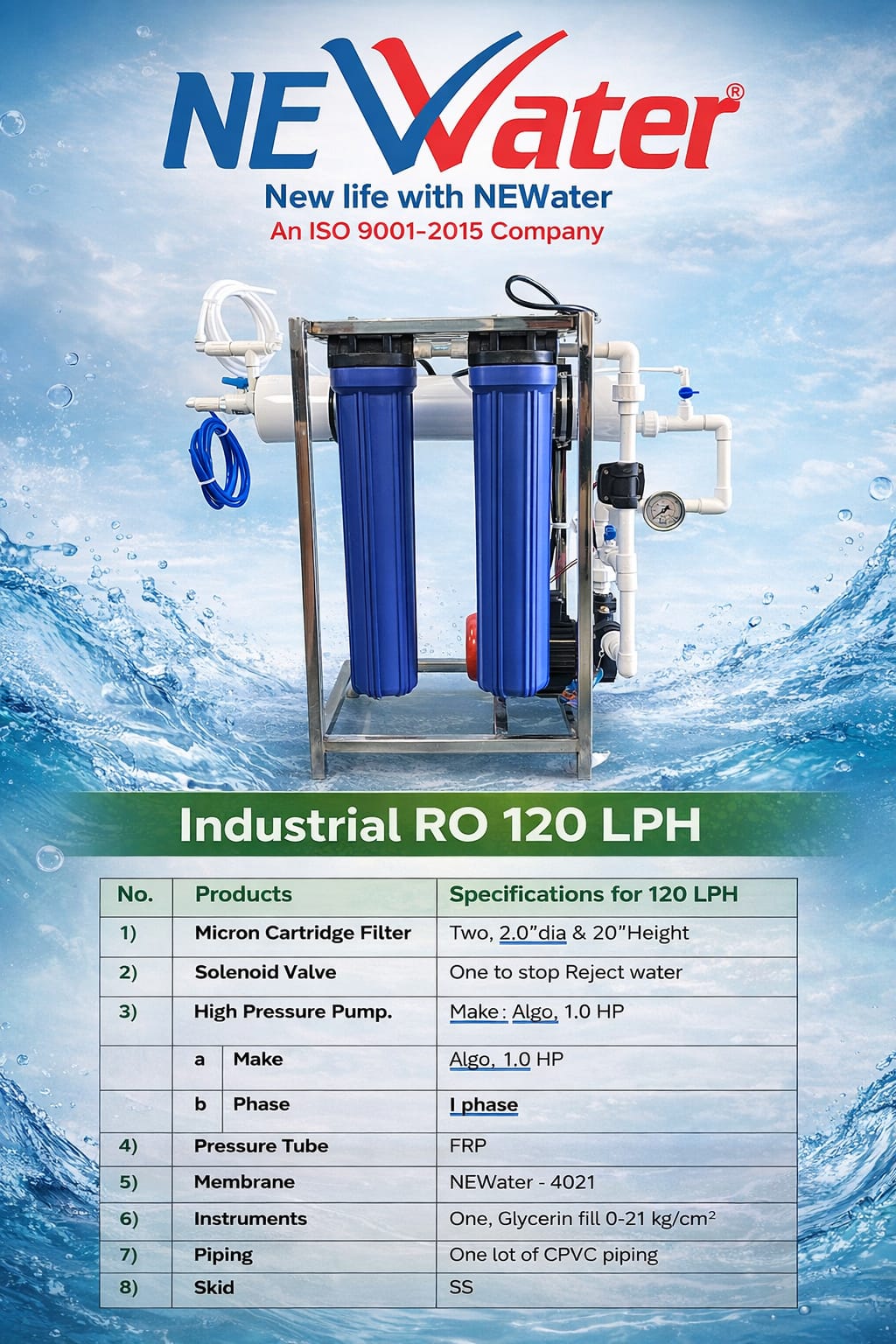 | Commercial RO Plants ₹30000 Ensure clean, safe, and high-quality water with the NEWater Industrial RO 120 LPH Plant. View product → |