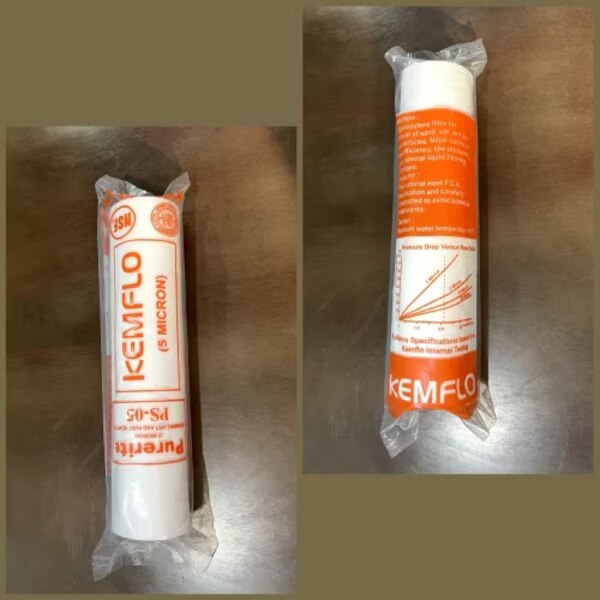
A cartridge marked “5 micron” does not tell you enough to predict its service life, pressure loss or outlet quality. By the end, you will be able to examine the cartridge structure, interpret its rating, match it to a housing and water source, and place it correctly among other treatment stages.
Key takeaways
- Compare beta ratios, pressure drop and dirt-holding capacity—not just micron ratings.
- Match cartridge length, diameter, end cap and flow rate to the housing.
- Replace the cartridge when pressure drop reaches your defined limit.
- Use spun filters for sediment before carbon, membranes or other treatment stages.
How the Fibres Trap Particles Through the Cartridge
A spun polypropylene cartridge is a depth filter because its thermally bonded fibres form a 3D media matrix, not a single filtering skin. Water travels through this tangled structure, where larger particles lodge between the outer fibres and smaller particles are intercepted deeper toward the core. The cartridge uses its entire thickness to hold solids.
That structure gives a spun filter cartridge more contaminant-holding volume than a thin surface screen with a similar nominal rating. A pleated cartridge concentrates filtration at the folds’ surface, while depth filtration distributes capture through the media. The trade-off is visibility: the outside can look clean even when internal pathways are filling.
As those pathways close, pressure drop can rise sharply near the end of the cartridge’s service life. Do not wait for discolouration or a sudden loss of flow; track inlet-to-outlet pressure when possible and set a replacement limit. Flow, water temperature and suspended-solids loading determine how quickly the rise occurs.
The fibres remove suspended particles, not dissolved salts, hardness, most dissolved metals or microorganisms. Treat the cartridge as particulate protection for downstream equipment, not as disinfection or complete water purification.
Why a 5-Micron Rating Is Not Enough for Comparison
Treat a micron number as a description of a test, not a guarantee of outlet quality. A nominal micron rating indicates expected particle removal under stated conditions; it does not prove that every particle larger than that size will be captured.
An absolute micron rating refers to a defined maximum particle size under a specified test method.
| Rating or evidence | What it tells you | What to verify |
|---|---|---|
| Nominal micron rating | Expected or percentage removal, such as 5 micron | Particle type, concentration, flow rate and removal percentage |
| Absolute micron rating | Maximum tested particle size under defined conditions | The test method and terminal pressure-drop limit |
| Beta ratio | Upstream-to-downstream particle count at a stated size | Beta ratio, test size and flow rate |
A 1 micron cartridge is not automatically more effective than a 5 micron filter cartridge. Fibre diameter, density gradient, media mass, cartridge length and core design can change both service life and outlet water. The same issue applies when comparing 10 micron, 20 micron and 50 micron cartridges.
Use a beta ratio for a sharper comparison: beta 1000 at 5 micron means 99.9% removal of particles at that test size and flow. Ask for the influent concentration and terminal pressure-drop criterion too.
A coarse-to-fine train usually protects the final cartridge better than several similar nominal ratings; select the upstream stage for larger solids and the downstream stage for required outlet quality.
How to Match the Cartridge to Flow, Housing and Replacement Limits
A cartridge fits only when its physical dimensions and operating limits match the housing. Confirm cartridge length, outer diameter, inner-core diameter, end-cap style, flow direction and gasket material before ordering; a better media grade cannot correct a physical mismatch.
Check these installation limits:
- Match a 10-inch filter cartridge or 20-inch filter cartridge to the housing’s usable cartridge length, not the nominal shell size. Allow space for compression and end-cap seating.
- Confirm the housing pressure rating, inlet-to-outlet flow direction, and required bypass or shutoff arrangement. An undersized housing can restrict flow even with suitable media.
- Compare the cartridge’s flow capacity at your actual water temperature and target pressure drop. Cold water, higher viscosity, peak demand and a denser media structure all increase clean pressure drop.
| Option | What it means | When it applies |
|---|---|---|
| 10-inch filter cartridge | Shorter media path and usually lower solids-holding volume | Compact housings, lower flow or limited installation space |
| 20-inch filter cartridge | Longer media path and greater available depth volume | Higher flow, greater solids loading or longer service intervals |
Treat differential pressure as the replacement control. Set the terminal differential pressure from the cartridge and equipment manufacturer’s limit; a calendar interval alone wastes cartridges in clean water and delays replacement in turbid water.
Depth media can show a steep late-life pressure rise, so monitor pressure across the cartridge rather than waiting for discoloration or a sudden outlet-flow failure.
Do not transfer a stated capacity in litres between sites unless solids concentration, particle-size distribution, flow and temperature are comparable. A high-turbidity source can exhaust the same cartridge far sooner.
Where a Spun Cartridge Belongs in a Treatment Train
Place the spun cartridge before chemical, membrane and disinfection stages. It removes suspended sediment such as rust, sand and silt, reducing particle loading before water reaches sensitive equipment.
| Water condition or contaminant | What the spun cartridge does | Equipment that handles the remaining problem |
|---|---|---|
| Suspended sediment, rust, sand and silt | Traps these particles through its depth | Protects the activated carbon filter, RO membrane, UV unit, valves and precision nozzles |
| Chlorine, pesticides and odour compounds | Does not reliably remove them | An activated carbon filter |
| Dissolved salts and hardness | Does not remove them | An RO membrane for dissolved salts; a water softener for hardness |
| Bacteria and viruses | Is not a microbiological barrier | A validated UV unit or other validated disinfection process |
A spun cartridge also protects a water softener by preventing abrasive solids from reaching its valve and resin bed. Select a coarse upstream stage before a finer spun cartridge when the source carries heavy sediment; otherwise, the fine cartridge loads quickly and restricts flow.
Flush a new melt-blown polypropylene cartridge until the outlet runs clear or the specified volume has passed. Manufacturing fines left in the water can foul an RO membrane, reduce UV performance and block narrow passages.
Do not treat “bacteria-resistant” media as a substitute for disinfection. Accept a microbial-reduction claim only when it identifies the organism, challenge level, flow, pressure and rated operating life. For potable water, check the exact model and claim under NSF/ANSI 42 or NSF/ANSI 53; certification of the housing alone proves nothing about contaminant reduction.
How to Choose Between Spun, Pleated, Wound, Bag and Carbon Filters
Choose a spun cartridge when your main problem is suspended sand, rust, silt or other non-dissolved solids and you need economical depth filtration. It suits prefiltration, but loading is less visible than on a surface filter, so use pressure-drop or replacement limits rather than appearance alone.
| Option | Best use | Main trade-off |
|---|---|---|
| Spun or melt-blown cartridge | General sediment depth filtration and coarse-to-fine filtration | Lower cost; verify the stated rating and flow |
| Pleated cartridge | Higher dirt-holding capacity or washable service | More expensive; surface loading can cause rapid blockage |
| String-wound cartridge | Deep filtration where gradual particle capture matters | Fibre shedding and material compatibility require checking |
| Sediment bag | High-solids water and large flow surges | Needs a suitable bag housing and frequent handling |
| Activated-carbon cartridge | Chlorine, taste and odour reduction | Does not replace sediment filtration or validated microbial treatment |
Before buying, verify these points:
- Match length, diameter, core and end-cap configuration to the housing; a cartridge that fits loosely can bypass water.
- Confirm the micron rating, rated flow, pressure-drop limit and replacement trigger. Install coarse media upstream of the finer stage instead of stacking similar ratings.
- Complete flushing to the specified volume or until the outlet runs clear. New polypropylene media can release fines into membranes, UV equipment, valves and nozzles.
- Check polypropylene chemical compatibility for the complete assembly, including seals and adhesives, against disinfectant concentration, temperature, pressure cycling and contact time.
- Treat “bacteria-resistant” wording as marketing unless the exact claim is validated. For potable water, check the model and contaminant claim under NSF/ANSI 42 or NSF/ANSI 53.
NEWater Technologies Pvt Ltd can help compare cartridge selection with the housing and treatment train, rather than choosing by micron number alone.
Related product
 | Spun Cartridge Introducing the Spun Filter Cartridge by Newater India, a high-quality filtration solution for clean and purified water. View product → |
Frequently asked questions
How does a spun cartridge trap particles?
Thermally bonded polypropylene fibres create a three-dimensional depth matrix. Larger particles lodge near the outside, while smaller particles travel deeper toward the core.
Why is a 5-micron rating insufficient for comparison?
A 5-micron label does not show whether the rating is nominal or absolute, the test method, beta ratio, pressure drop or dirt-holding capacity.
How do you match a cartridge to its housing and flow rate?
Check the cartridge length, outside and inside diameters, end-cap configuration, seal material, connection type and rated flow. Confirm the housing accepts those dimensions and the required flow without excessive pressure drop.
Where should a spun cartridge be installed in a treatment train?
Install it as a sediment prefilter before stages such as activated carbon, ultraviolet treatment or reverse osmosis when those components need protection from suspended solids.
When should you choose spun, pleated, wound, bag or carbon filtration?
Choose spun media for depth sediment removal, pleated media for greater surface area and cleanability, wound media for graded depth filtration, bag filters for higher-volume coarse solids, and carbon for chlorine, taste and odour reduction.