A plant rated at 500 or 3,000 litres per hour is not automatically the right fit: the rating might describe feed flow rather than usable product water. By defining demand, testing the source, matching treatment to contaminants, and checking utilities, waste handling and maintenance, you can turn a catalogue choice into a reliable treatment specification.
Key takeaways
- Size the plant from hourly demand, peak use and operating hours.
- Test feed water before selecting filters, membranes or disinfection.
- Match treatment technology to contaminants and the water’s final use.
- Specify acceptance tests for flow, quality, recovery and fault response.
Start with the water balance, not the plant rating
Start with required product-water volume: plant sizing follows use, not the source name or a catalogue LPH figure. Record average hourly demand, busiest hour, daily water demand, operating hours, shift patterns and seasonal peak consumption.
1. Divide daily demand by planned run hours to find minimum permeate capacity. If you need 12,000 litres during 10 operating hours, you need 1,200 LPH of product water before adding capacity for membrane cleaning, backwash, downtime and future demand.
2. Define each flow separately: raw-water feed, permeate output and reject or concentrate. Ask whether a quoted 500, 1,500, 3,000 or 10,000 LPH describes feed flow or product output, then request the stated recovery percentage. At 50% recovery, producing 1,500 LPH requires about 3,000 LPH of feed and creates about 1,500 LPH of concentrate.
3. Size storage against peak draw-off, not the largest available tank. A buffer tank can cover short peaks, but it consumes floor space and creates cleaning and microbial-control duties. Include tank turnover, low-level cut-outs, high-level shutdown and emergency reserve in the design basis.
Size raw-water, permeate and reject lines independently. Compare production with peak consumption to set tank capacity, and leave enough reserve for cleaning or an unexpected outage; a plant that meets average demand but fails during the busiest hour is undersized.
Test the feed water before choosing the treatment train
A single grab sample can hide the turbidity, scaling and microbial peaks that later damage a plant. Base the design on feed-water testing during monsoon and dry-season conditions, or whenever the source changes.
Include these parameters in the design-basis analysis:
- Turbidity, temperature, pH, alkalinity, hardness, conductivity/TDS, iron, manganese and silica
- Organics and microbiology
- Site-specific oil, solvents, pesticides, PFAS, colour, sulphide or other chemicals that could affect treatment or disposal
| Finding | Pretreatment to compare | What goes wrong without it |
|---|---|---|
| Suspended solids or high turbidity | Pressure sand filtration; coagulation and clarification for heavier loads | Fouling, blocked cartridges and rapid pressure loss |
| Chlorine, taste, odour or selected organics | Activated carbon | Membrane damage or poor water quality |
| Hardness or scale-forming water | Softening or antiscalant dosing | Scale reduces RO flow and salt rejection |
| Dissolved iron or manganese | Oxidation followed by catalytic media or filtration | Deposits, colour and irreversible membrane fouling |
| Colloids or microorganisms | Ultrafiltration | Particle and biological fouling downstream |
| Final particulate risk | Cartridge filtration | Debris reaches pumps or membranes |
Remove free chlorine before polyamide RO membranes unless the selected membrane is chlorine-tolerant. Request feed-water limits, chemical doses, expected pressure drop and replacement intervals for every pretreatment stage. Assess backwash water, spent carbon, regenerant and chemical-cleaning waste before approving the train, because disposal capacity can reject an otherwise workable design.
Match the technology to the contaminant and end use
Choose RO when you need broad removal of dissolved salts, not simply because the feed water is dirty. Low-TDS water needing pathogen control may need UV disinfection, chlorination or both; demineralisation adds cost without solving a different problem.
| Option | Main target | When it applies |
|---|---|---|
| RO | Broad range of dissolved salts | High TDS or application-specific low-conductivity water |
| Ultrafiltration | Suspended solids, colloids and many microorganisms | Clarified water and microbial or particulate barriers |
| Nanofiltration | Some hardness, colour and dissolved organics | Partial softening without full demineralisation |
| Ion exchange | Selected dissolved ions | Nitrate, hardness or other defined ionic contaminants |
| Cation-exchange softener | Calcium and magnesium | Hardness control; it does not remove pathogens, neutral organics or most dissolved salts |
| UV disinfection | Microbial inactivation | Clear, low-turbidity water with no residual-disinfection requirement |
Compare RO versus ultrafiltration on recovery, electricity, chemical cleaning, replacement parts, operator skill and reject or backwash volume. A softener also consumes salt or potassium and produces regeneration wastewater.
For UV disinfection, request validated dose data, UV transmittance limits, flow range, lamp-output monitoring, sleeve-cleaning instructions and low-dose alarms. For chlorine, specify pH, temperature, concentration, contact time and residual; use CT, not injector size alone. UV leaves no persistent residual, so a storage tank or long distribution loop may need chlorine or chloramine afterward.
For potable water, match the exact certified claim to the end use. NSF/ANSI 61 covers health effects of system components; NSF/ANSI 42, 44, 53, 55, 58 and 401 cover different treatment classes or contaminant claims.
Check membrane design, utilities and failure tolerance
A membrane plant that quotes only litres per hour is underspecified. Demand a design basis tied to the tested feed chemistry, not a catalogue output.
1. Request the membrane selection details: membrane type, element size and count, design flux, operating pressure range, target salt rejection, recovery, temperature correction and feed-water compatibility. Require projected permeate flow, salt passage, concentrate quality and cleaning frequency at that chemistry.
2. After commissioning, record normalized permeate flow, salt passage and differential pressure. Falling normalized flow indicates fouling or scaling; rising salt passage points to membrane damage, seal bypass or incorrect operating conditions.
3. Confirm the high-pressure pump type, motor rating, electrical phase and voltage, starting current, power consumption and standby arrangement. Specify duty/standby pumps, parallel trains, sample ports before and after each barrier, automatic isolation and a bypass policy that never compromises treated-water safety.
4. Check the control panel for pressure switches, flow meters, conductivity or TDS instruments, tank-level controls, dosing interlocks, alarms, automatic shutdown and data logging. Reserve access for cartridge changes, membrane removal, chemical cleaning, tanks and panels.
5. Confirm disposal routes for RO concentrate, backwash, regenerant, sludge and cleaning chemicals before setting recovery. Higher recovery reduces water loss but concentrates salts and scaling risk; an unapproved discharge can stop an otherwise capable plant.
Turn the specification into a purchase and commissioning test
Do not compare supplier quotes until every bidder has the same design basis: feed-water analysis and seasonal range, required product volume, operating schedule, end-use standard, available power, floor plan and permitted discharge route. A supplier comparison based only on an LPH label hides feed flow, recovery, waste volume and actual operating cost.
Request these documents before purchase:
- P&ID, mass balance, equipment list, pump curves and membrane projection
- Chemical-consumption estimate, utility schedule, spare-parts list and maintenance plan
- Guarantees at named feed conditions for permeate flow, recovery, conductivity or salt rejection, pressure, temperature and operating hours
| Document | Why it matters |
|---|---|
| P&ID and mass balance | Exposes missing instruments, flows and concentrate volume |
| Membrane projection | Tests recovery, salt passage, cleaning frequency and scaling risk |
| Utility schedule | Confirms power, water, chemicals and discharge capacity |
| Maintenance plan | Shows access, spares, service intervals and operator tasks |
Define commissioning and acceptance testing before delivery. Test product flow, conductivity, residual disinfectant, microbial quality, alarms, automatic shutdown and tank-level control at the agreed feed conditions. Record baseline pressure, normalized flow, salt passage and differential pressure; these values reveal fouling, scaling or membrane damage later.
NEWater Technologies Pvt Ltd is useful when it turns those measurements into a site-specific design, installation checklist and support plan. Compare service access, operator training and response arrangements with equipment price, and reject any proposal omitting feed limits, concentrate handling, electrical requirements or acceptance criteria.
Related products
 | Industrial RO Plant Looking for a reliable and efficient solution for clean and safe drinking water? Look no further than NEWater Technologies Pvt. Ltd. View product → |
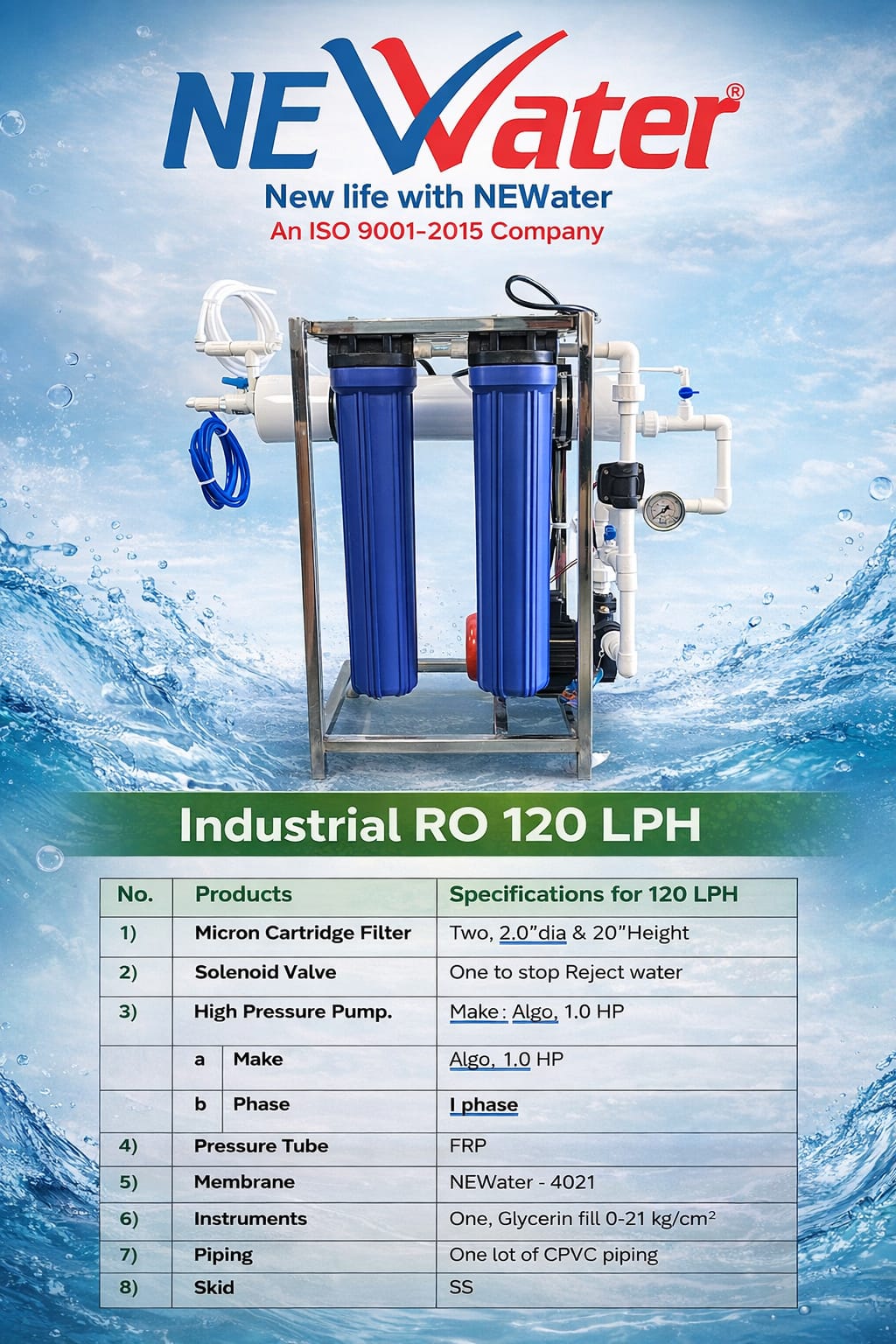 | Commercial RO Plants ₹30000 Ensure clean, safe, and high-quality water with the NEWater Industrial RO 120 LPH Plant. View product → |
Frequently asked questions
What information do you need to size a water purification plant?
Record average hourly demand, busiest-hour demand, daily consumption, operating hours, shift patterns and seasonal peaks. Size production and storage around these figures rather than relying on a catalogue LPH rating.
Why should you test feed water before choosing treatment equipment?
A laboratory report identifies contaminants that determine the treatment train. Test parameters such as turbidity, TDS, hardness, iron, manganese, silica, chloride, nitrate, microbiological quality and pH before selecting filters, membranes or disinfection.
How do you match purification technology to the application?
Choose treatment from the contaminant and end-use specification. Reverse osmosis addresses dissolved salts, activated carbon removes chlorine and many organic compounds, softeners reduce hardness, ultrafiltration removes suspended solids and microorganisms, and ultraviolet treatment inactivates microorganisms without removing dissolved contaminants.
What should a water treatment plant specification include?
State feed-water limits, product-water targets, flow at defined temperature and pressure, recovery, reject-water handling, power and chemical requirements, membrane configuration, alarms, maintenance access and spare parts. Include commissioning tests for output, quality and failure response.
Related products
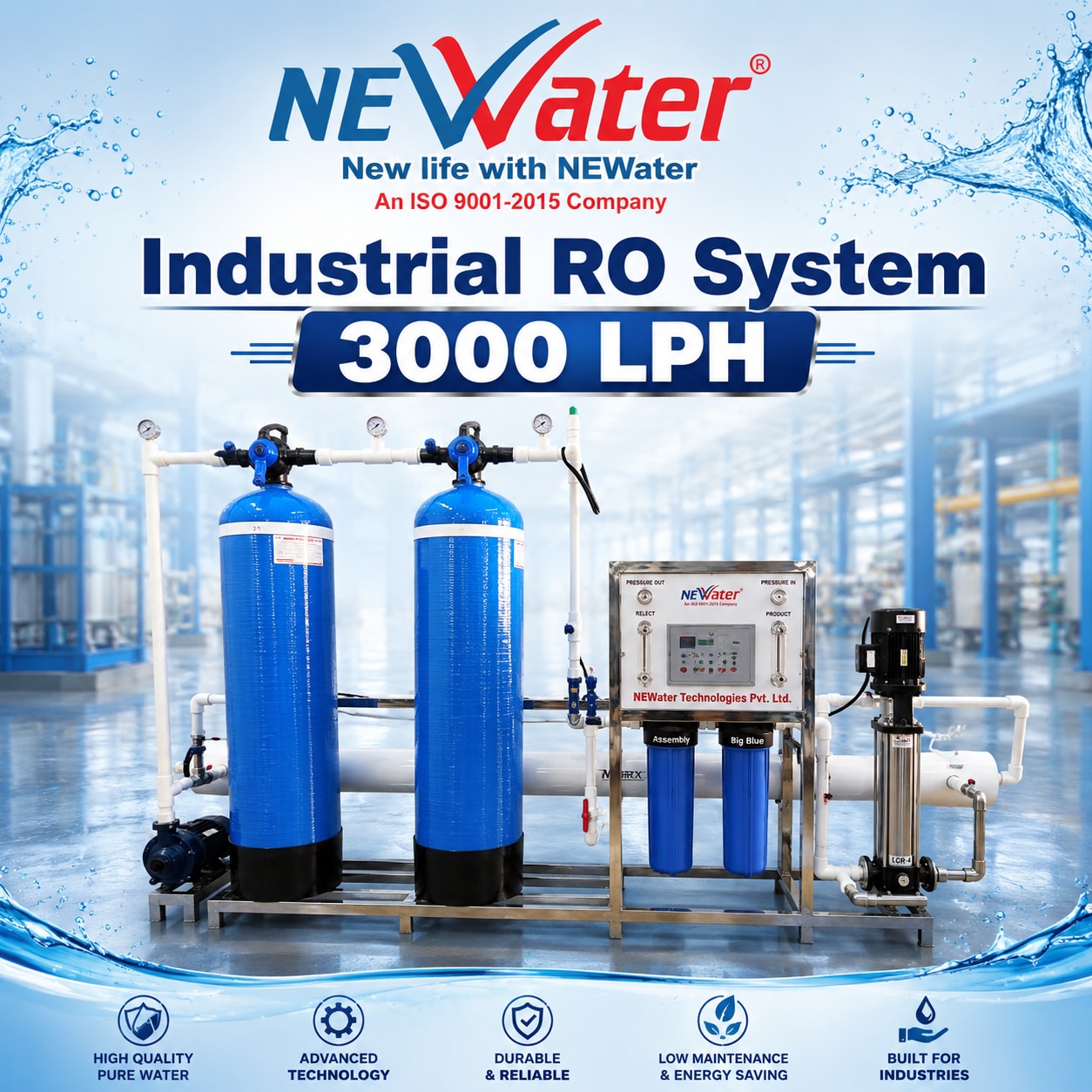 | Industrial RO Plant Introducing the FRP RO Plant by Newater India, a cutting-edge water treatment solution for clean and purified water. View product → |
 | FRP RO PLANTS Introducing the FRP RO Plant by Newater India, a cutting-edge water treatment solution for clean and purified water. View product → |
 | FRP RO PLANT 500 LPH Fully Automatic RO Plant Are you in need of a high-quality industrial RO Plant for your business? Look no further, as we are a leading manufacturer of industrial RO Plants... View product → |
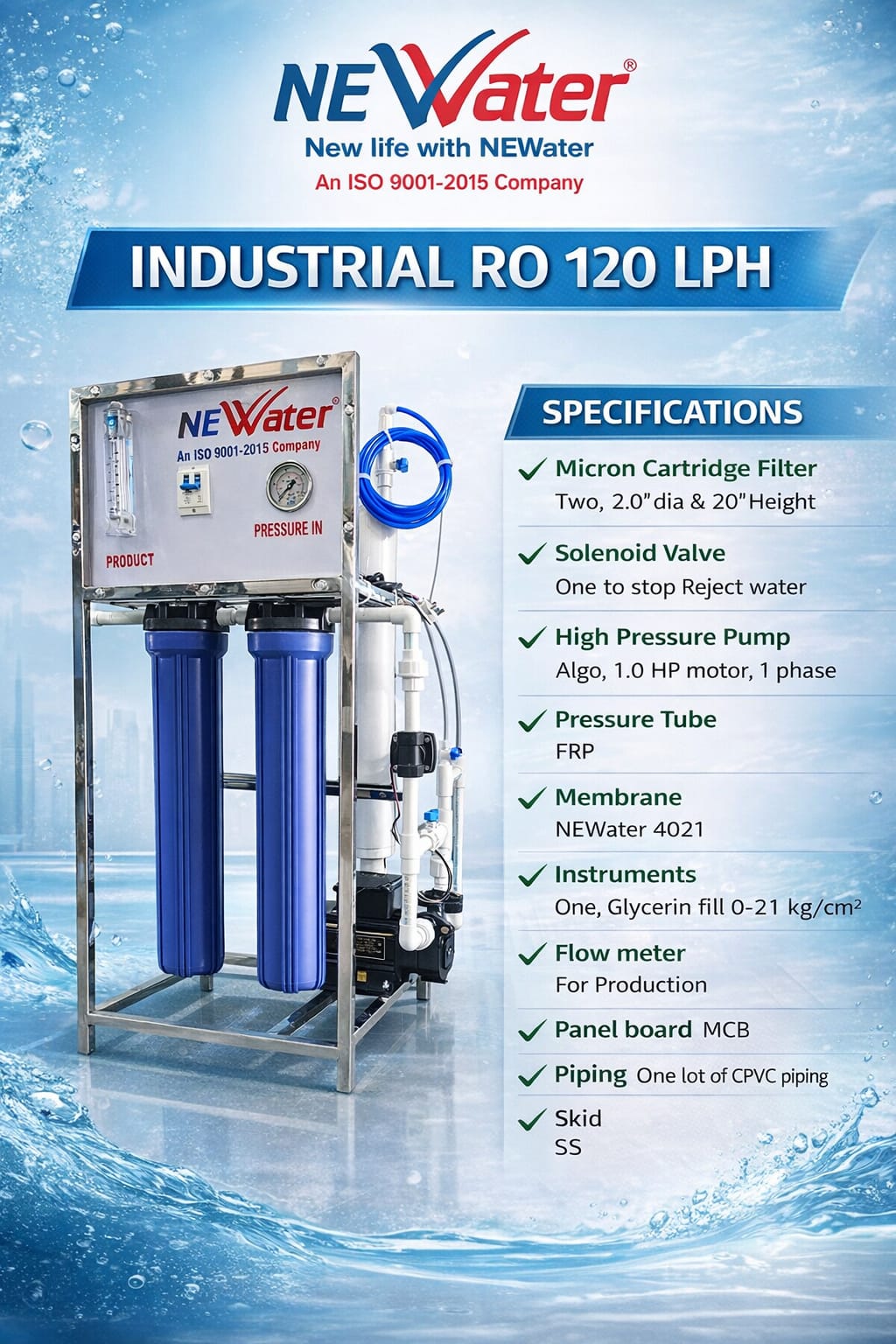 | Industrial RO Plant ₹33000 Upgrade your commercial water treatment capabilities with the NEWater Industrial RO 120 LPH Plant. View product → |