Before purchasing treatment equipment, define what you are legally selling, confirm that the water source can support it, and calculate saleable output rather than trusting a machine’s nominal LPH rating. By the end, you will have a practical framework for selecting the site, treatment train, storage, filling system and operating controls your plant needs.
Key takeaways
- Choose the legal product category before selecting treatment equipment.
- Test the source water and inspect the site before construction.
- Size treatment and filling capacity from realistic sales forecasts.
- Use raw-water results to select membranes, filters and disinfection steps.
Choose the Product Category Before Designing the Plant
A product category determines the source, treatment train, testing plan and label claims before you buy equipment. Decide whether you will sell natural mineral water, spring water or packaged drinking water, then check the classification rules for a purified waterplant in your jurisdiction.
Source protection starts with the borehole or spring catchment, sanitary zone and recharge area—not with the final filter.
| Option | Legal identity | Plant-design consequence |
|---|---|---|
| Natural mineral water | Protected underground source with stable mineral composition | Preserve the characteristic profile. Limit treatment to permitted removal of unstable constituents, iron, manganese, sulfur compounds or excess carbon dioxide; unrestricted reverse osmosis can destroy the identity. |
| Spring water | Water collected from a protected spring under local rules | Design capture, sanitary protection and low-impact treatment around the source. Confirm which treatments and source claims the licence permits. |
| Packaged drinking water | Water prepared for sale in sealed containers | Allows a broader treatment train, including reverse osmosis, but requires remineralization, pH stabilization, corrosivity control and reject-water disposal. |
Do not select RO because it produces attractive laboratory numbers. Low-alkalinity permeate can taste flat, attack metal and create distribution problems unless calcium, alkalinity and final pH are controlled. Map sampling points at the source, after treatment, at the filler and in finished packages, then match microbiological limits to local law.
Your legal treatment and label claims must describe what the approved category permits.
Check the Source and Site Before You Commit to Construction
Do not buy land on the strength of one laboratory report. Confirm that the raw-water source can support the product category you intend to sell: natural mineral water needs a protected underground source with stable composition, while packaged drinking water permits broader treatment.
1. Verify the source ownership, yield and reliability. For a borewell, obtain borewell permission before construction and record pumping rates, static water level and nearby wells. For a spring, inspect the catchment and collection works.
2. Arrange seasonal water testing during dry, rainy and post-monsoon conditions. Compare TDS, hardness, alkalinity, pH, turbidity, iron, manganese, chloride, fluoride, nitrate, sulphate and microbiological counts. A chemical pass in one month does not prove year-round safety.
3. Map the source protection zone and groundwater recharge area. Check septic systems, agriculture, industrial activity, fuel storage, flooding and waste disposal nearby. Contamination at the source will not be solved reliably by adding stronger downstream treatment.
4. Measure the land area needed for treatment, storage, filling, vehicle movement and future expansion. Confirm positive site drainage and keep sanitary separation between processing rooms and toilets, waste areas and chemical storage.
5. Confirm dependable electrical supply, transformer capacity, backup generation and road access for tankers, packaging deliveries and finished-goods vehicles. Test whether the access road remains usable during heavy rain.
Secure written approvals and source records before finalising the layout; otherwise, a cheap plot can become an expensive relocation.
Convert Sales Forecasts Into Real Treatment and Filling Capacity
Base capacity on expected saleable water, not the filler’s advertised speed. Your water demand calculation starts with bottle sales and jar sales: multiply each package quantity by its volume, then add the results to obtain litres per day. For example, 10,000 one-litre bottles plus 500 twenty-litre jars require 20,000 litres per day before process losses.
- Convert litres per day into hourly demand using actual production hours, not a 24-hour day. Add peak demand, seasonal orders and future growth to this figure.
- Calculate raw-water demand by allowing for pretreatment backwash, membrane recovery, rejected containers, changeover losses and CIP demand. Divide required finished water by the treatment recovery percentage, then check that source yield can sustain it.
- Select treatment equipment above the calculated rate, because nominal LPH is not the same as delivered production. Include a maintenance reserve so one pump, filter or membrane train can be offline without stopping filling.
- Size filling capacity from containers per hour for each format. A filler that handles 2,000 one-litre bottles per hour may not deliver the same output for 20-litre jars.
Storage must cover the gap between source availability, treatment hours and filling demand. Provide separate raw-water and treated-water tanks, sized for operating buffers, cleaning, downtime and the source’s seasonal limits; avoid storing finished water longer than your hygiene plan permits.
A standby pump, generator, parallel treatment train or extra storage provides backup capacity when maintenance or a source interruption removes equipment from service.
Match the Treatment Train to the Raw-Water Test Results
Do not select pumps, membranes or filters from the borewell’s TDS alone. Test the source in a laboratory for hardness, alkalinity, pH, turbidity, iron, manganese, chloride, fluoride, nitrate, sulphate, microbiological count and seasonal variation. The results determine both the treatment sequence and the equipment’s duty.
| Test result or risk | Treatment stage | Equipment decision |
|---|---|---|
| High turbidity, suspended solids or variable colour | Multimedia filter, then activated carbon | Size for peak flow, not average flow |
| Iron or manganese | Iron removal before fine filtration | Add oxidation and a dedicated iron removal filter when concentrations exceed the media’s rated capacity |
| Hardness, high alkalinity or scaling tendency | Softener or antiscalant before reverse osmosis | Select dosing from hardness, recovery and membrane projection data |
| High TDS, fluoride, nitrate, chloride or sulphate | Reverse osmosis | Confirm recovery, reject-water disposal and membrane compatibility |
| Low alkalinity or acidic permeate | Remineralisation and pH stabilisation | Control calcium, alkalinity and final pH to prevent corrosive water |
| Microbial count or poor UV transmittance | Cartridge filter, then UV or ozone | Validate UV dose at maximum flow; test bromate when ozone meets bromide |
For natural mineral water, do not automatically install reverse osmosis: removing minerals can destroy the product’s legal identity. Use only treatments permitted for the declared category and verify that essential composition remains unchanged.
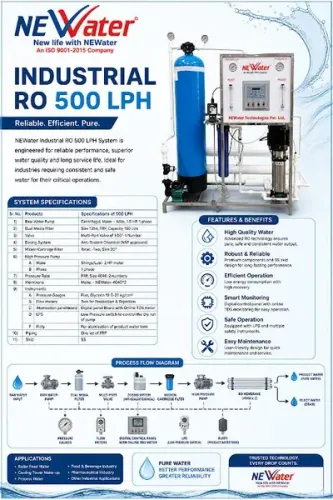
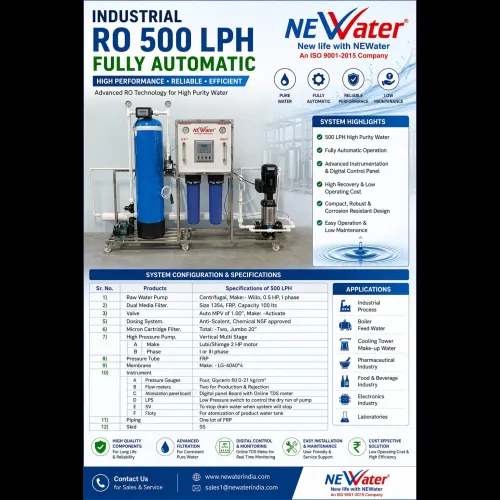
Give NEWater Technologies Pvt Ltd the complete laboratory report and required flow rate, not just a TDS figure, before asking for an equipment proposal.
Related products
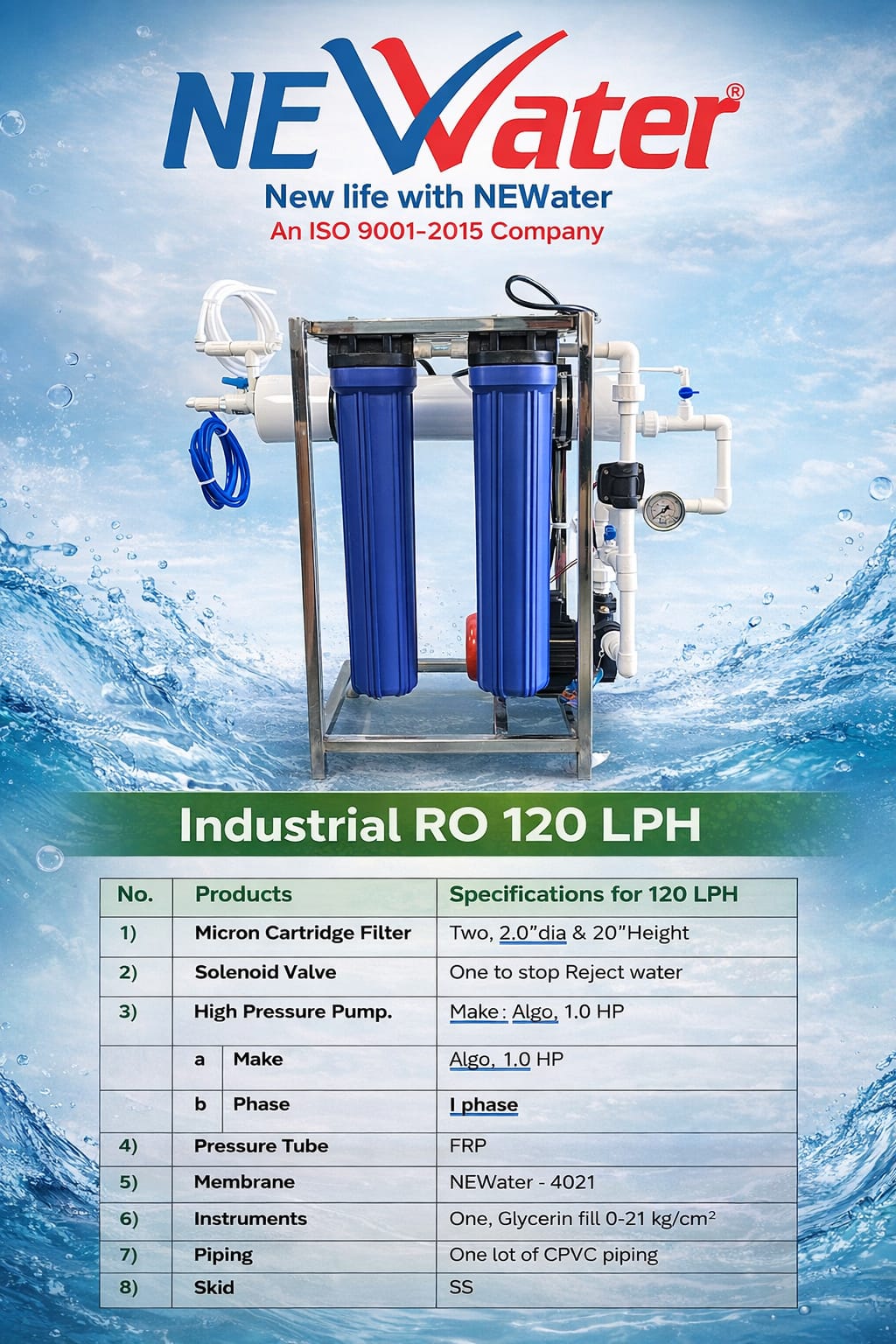 | Commercial RO Plants ₹30000 Ensure clean, safe, and high-quality water with the NEWater Industrial RO 120 LPH Plant. View product → |
 | Industrial RO Plant Looking for a reliable and efficient solution for clean and safe drinking water? Look no further than NEWater Technologies Pvt. Ltd. View product → |
Control Recovery, Hygiene and Finished-Product Risk
A plant loses water long before a rejected bottle reaches the warehouse. Build the mass balance around saleable litres, not filler speed, and set a target for permeate recovery. Measure reject water from membranes and backwash, then assess reject reuse only after confirming its chemistry and microbiological safety.
Size drain capacity for peak discharge, including CIP and emergency dumping.
Include these loads in the balance:
- Source-yield variation and seasonal restrictions
- Pretreatment backwash and membrane cleaning
- CIP demand, changeover losses and rejected containers
- Planned downtime and treated-water storage
Verify feed-water temperature and pressure at operating extremes; both alter membrane output and recovery. Check UV transmittance before relying on UV disinfection. If ozone is used, test bromate at the maximum ozone dose, contact time, pH, temperature and bromide concentration; the WHO guideline value is 0.01 mg/L.
Treat the filling room as high-care. Control personnel movement, wet surfaces, compressed air, bottle rinsing, filling and capping, because a compliant source can become contaminated there. Keep product-contact tanks, pipework, filler bowls, cap equipment and dead legs inside a written CIP programme.
CIP validation requires evidence from the actual worst-case circuit: chemical concentration, temperature, contact time, flow velocity, rinse endpoint and microbiological results. HACCP must cover food-contact packaging, carbonation, label and batch traceability, and finished-goods storage, including migration, odour, closure failure and cleaning-agent carryover. Test and document every release.
Frequently asked questions
Which product category should you choose before designing the plant?
Choose between natural mineral water, spring water and packaged drinking water first. The category affects your source, treatment process, testing plan and label claims.
What should you check before committing to a plant site?
Test the proposed water source and review site conditions before construction. Confirm that the source and location meet the classification and licensing rules in your jurisdiction.
How do you convert sales forecasts into plant capacity?
Translate expected sales into daily water volume, then size treatment, storage and filling equipment around that demand. Include operating hours, cleaning time, downtime and peak demand.
How should raw-water test results influence the treatment train?
Select treatment steps from measured contaminants and water characteristics. Results determine whether you need processes such as filtration, softening, activated carbon, reverse osmosis or disinfection.
Related products
 | Industrial RO Plant The RO Plant is a highly efficient and reliable water purification system designed to provide clean and safe drinking water. View product → |
 | Industrial RO Plant 250 LPH FULLY AUTOMATIC RO PLANT At our company, we are proud to offer the high-quality 250 LPH FRP RO plant that is perfect for industrial applications. View product → |
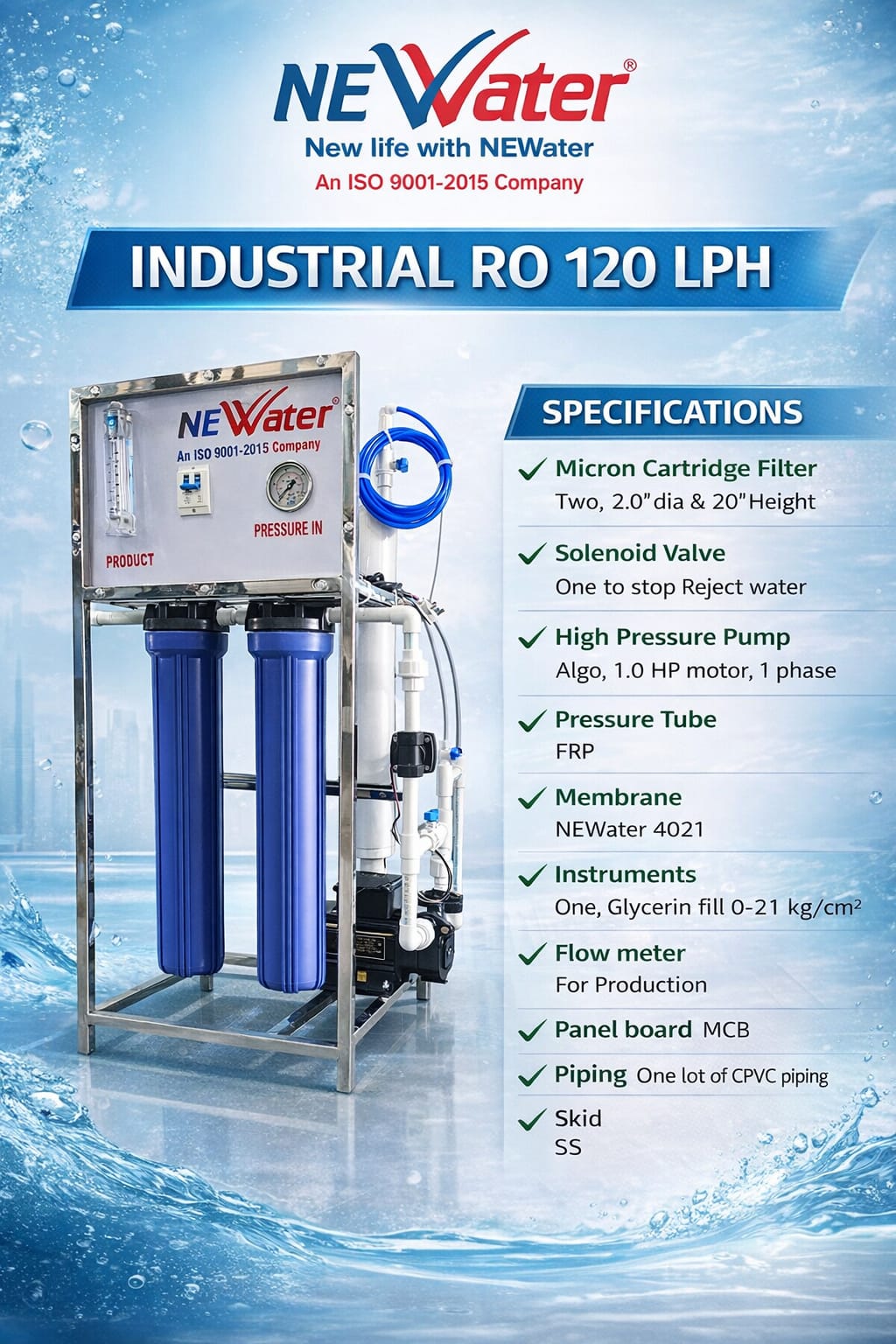 | Industrial RO Plant ₹33000 Upgrade your commercial water treatment capabilities with the NEWater Industrial RO 120 LPH Plant. View product → |
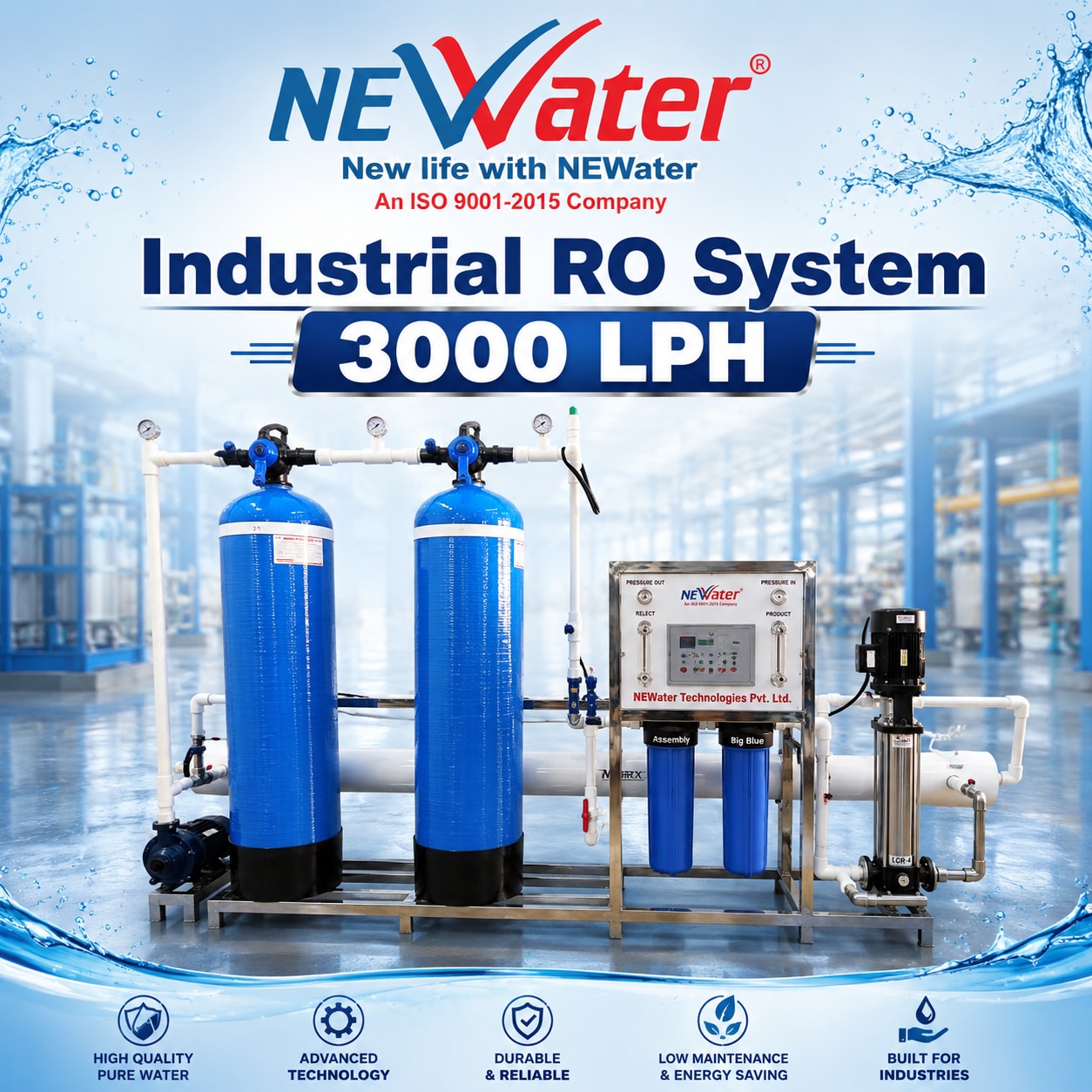 | Industrial RO Plant Introducing the FRP RO Plant by Newater India, a cutting-edge water treatment solution for clean and purified water. View product → |