A 4000 LPH RO plant is not automatically a 4,000-litre-per-hour supply at every outlet. You will be able to calculate usable production, specify feed and reject flows, size storage and pretreatment, and compare one 4000 LPH train with alternative configurations before requesting quotations.
Key takeaways
- Treat 4000 LPH as rated permeate output, not feed-pump flow.
- Size for peak demand, reserve capacity, recovery and membrane downtime.
- Test feed water before selecting pretreatment, membranes and operating controls.
- Compare trains by redundancy, maintenance access, storage needs and actual output.
What 4000 LPH Means in Actual Daily Operation
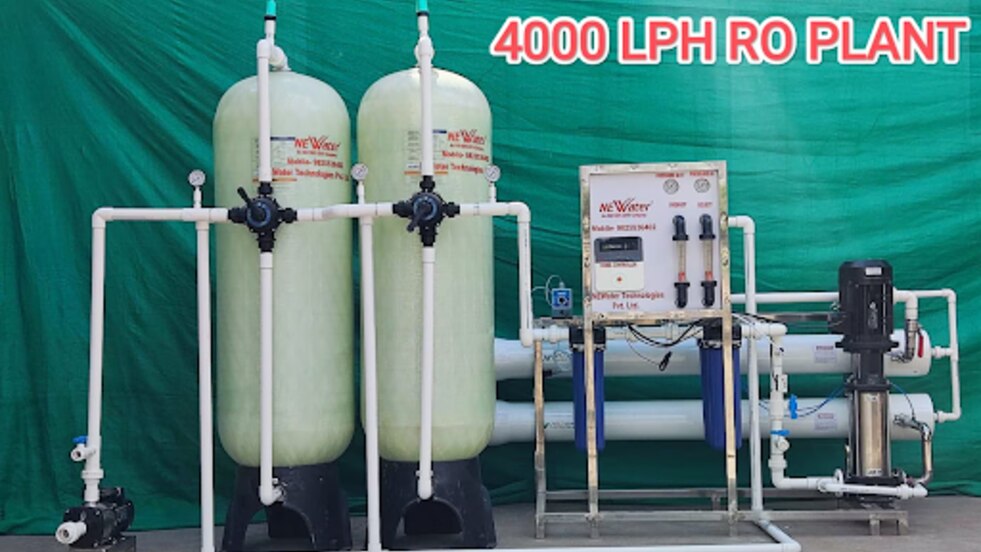
A 4000 LPH RO plant is rated to deliver 4000 litres per hour of permeate, or usable product water, at specified feed temperature, pressure, salinity, recovery and membrane condition. It does not mean 4000 litres per hour at every outlet, and it does not describe feed-pump flow.
At uninterrupted 24-hour operation, the nameplate equals 96,000 litres per day. An eight-hour shift produces about 32,000 litres, or 32 m³. Actual available supply falls when cleaning, maintenance, pretreatment backwash, low-level interlocks or other downtime stop production. Tank capacity and distribution limits also determine how much users receive.
Recovery changes the flows behind the permeate production. At 75% recovery, 4.0 m³/h of permeate requires about 5.33 m³/h of feed and creates 1.33 m³/h of concentrate. At 60%, feed rises to 6.67 m³/h and concentrate to 2.67 m³/h.
An eight-hour shift therefore creates roughly 10.7 m³ or 21.3 m³ of concentrate, respectively—a continuous waste stream requiring an approved disposal or reuse route.
- Guaranteed permeate production at the stated reference temperature and feed analysis
- Feed flow and high-pressure-pump duty at membrane operating pressure
- Concentrate flow and expected daily volume
If demand reaches 8 m³/h for two hours, the skid alone cannot supply it. You need extra RO capacity or about 8 m³ of usable storage, plus reserve volume and unusable tank capacity.
How to Size the Plant for Peak Demand, Reserve and Recovery
A 4000 LPH plant meets actual demand only when its 4.0 m³/h permeate output, operating time, storage and peak draw are checked together. It does not supply 4,000 litres to every outlet continuously.
1. Record the facility’s peak hourly demand, not just its daily total. Note each process, shift, cleaning cycle and simultaneous draw.
If demand reaches 8 m³/h for two hours, the RO plant alone cannot cover it; you need extra capacity or about 8 m³ of usable treated-water storage, plus reserve, unusable tank volume and level-control deadband.
2. Complete the RO plant sizing calculation: required permeate = daily demand plus reserve, divided by planned operating hours. A 4.0 m³/h plant produces about 32 m³ in an eight-hour shift or 96 m³ in 24 hours before downtime, cleaning and storage limits.
Size raw-water supply, backwash capacity, chemical storage and concentrate disposal from that operating schedule.
3. Check the recovery rate and all flows on the quotation. At 75% recovery, 4.0 m³/h permeate requires about 5.33 m³/h feed and produces 1.33 m³/h concentrate. At 60%, those figures become 6.67 and 2.67 m³/h. Request rated permeate output, reference temperature, feed analysis, feed flow, membrane pressure and concentrate discharge.
Treat the nameplate as a rated condition, not a constant guarantee. Temperature, salinity, fouling and membrane age change output, so confirm the design margin before selecting the pump or tank.
Which Feed Tests and Pretreatment Stages the System Needs
A complete feed-water analysis—not TDS alone—determines the pretreatment train, membrane type, recovery and operating pressure for a 4000 LPH installation. The report should identify the design temperature and pressure because membrane output changes with temperature, salinity, fouling and age.
| Feed result | Design decision | Likely treatment |
|---|---|---|
| TDS, conductivity and ion profile | Membrane selection, staging and pressure | Brackish-water RO; adjust recovery to the scaling load |
| pH, hardness and alkalinity | Calcium-carbonate scaling risk | Softener, antiscalant or pH correction |
| Turbidity and SDI | Particulate and colloidal fouling risk | Multimedia or cartridge filtration; target SDI 5 or lower when the membrane maker specifies it |
| Free chlorine | Polyamide membrane compatibility | Activated-carbon filter or chemical dechlorination |
| Iron, manganese and silica | Fouling, oxidation and difficult scale | Oxidation and filtration, specialist media, or tighter recovery |
| Temperature and feed pressure | Permeate flow and pump selection | Confirm the membrane array at site conditions |
Specify turbidity alongside SDI; a nominal 5-micron cartridge does not prove low colloidal fouling. Track SDI, cartridge differential pressure and RO-feed-filter condition.
A typical train uses raw-water screening, particulate filtration, dechlorination where polyamide membranes are installed, hardness control or antiscalant dosing, a cartridge filter, then the high-pressure pump and RO array. Test microbial contamination when the source is untreated; add disinfection without exposing the RO membranes to free chlorine.
Salt passage and recovery must be checked against the full analysis, not the 4000 LPH nameplate.
How to Compare One 4000 LPH Train with Other Plant Configurations
Choose one 4000 LPH train when demand is steady, space is limited and stopping the entire water supply during maintenance is acceptable. Choose two 2000 LPH trains when redundancy matters: one train can keep essential users supplied while the other is cleaned or repaired.
Choose a 5000 LPH plant when forecast demand is close to 4000 LPH and you need operating margin rather than a separate standby train.
| Option | Best fit | Main compromise |
|---|---|---|
| One 4000 LPH train | Stable demand and lower footprint | One failure removes the full production capacity |
| Two 2000 LPH trains | Maintenance during production and partial-load operation | More valves, controls, instruments and installation space |
| 5000 LPH plant | Growth, peak demand or extra hourly capacity | It adds capacity, not redundancy; one fault can still stop production |
The 4000 LPH versus two 2000 LPH RO plants decision must include the consequence of one train stopping, not only purchase price. Two trains also let you match production to demand more closely, reducing unnecessary starts and stops.
Check every quotation’s rated permeate flow, feed flow, recovery, concentrate flow and reference temperature. A 4000 LPH rating means 4.0 m³/h of permeate, not 4.0 m³/h through the high-pressure pump. At 75% recovery, the pump must supply about 5.33 m³/h; at 60%, about 6.67 m³/h.
A 5000 LPH RO plant comparison is meaningful only when both ratings use the same feed analysis, temperature, recovery and membrane condition.
How to Control Recovery, Storage, Distribution and Long-Term Performance
At 75% recovery, producing 4,000 LPH requires about 5,330 LPH of feed and creates 1,330 LPH of concentrate. At 60% recovery, those figures become 6,670 LPH and 2,670 LPH. Set recovery from feed chemistry, antiscalant limits and concentrate disposal capacity—not from the permeate target alone.
Poor control increases scaling, shortens RO recovery and membrane life, and reduces output.
1. Record the commissioning baseline: feed pressure, temperature, conductivity, permeate flow, permeate conductivity, recovery and pressure drop across each stage. Confirm that storage covers production interruptions; eight hours at 4,000 LPH yields about 32 m³, while 24 hours yields about 96 m³ before downtime and cleaning.
2. Control the permeate tank with level sensors and a high-level shutdown. Use a dedicated distribution pump sized for peak outlet demand, protect the tank from contamination with a closed vent and screened overflow, and prevent dead legs where water can stagnate.
3. Route concentrate to an approved reuse, evaporation, sewer or treatment arrangement after checking local discharge limits. Never send concentrate to a drain without confirming flow, salinity, chemicals and permission.
4. Compare each service reading with the baseline using normalized permeate flow and normalized salt passage. Start cleaning when normalized flow falls about 10%, normalized salt passage rises 5–10%, or pressure drop rises 10–15%, unless the membrane supplier specifies tighter limits.
NEWater Technologies Pvt Ltd can be asked to state these baseline values, reference temperature, feed analysis and concentrate flow on the commissioning record, so later performance checks test the design duty rather than a vague nameplate.
Frequently asked questions
What does 4000 LPH mean in daily RO plant operation?
It means the plant is rated to produce 4000 litres of permeate per hour under specified feed temperature, pressure, salinity, recovery and membrane condition. It does not mean every outlet receives 4000 LPH or that the feed pump moves 4000 LPH.
How do you size a 4000 LPH RO plant for peak demand?
Calculate hourly demand during the busiest operating period, then account for reserve capacity, storage volume, recovery and time lost to cleaning or maintenance. Match the plant to the required usable-water output rather than the nameplate alone.
Which feed-water tests and pretreatment stages does an RO plant need?
Test the source for salinity, hardness, turbidity, iron, manganese, silica, pH, temperature, chlorine and microbiological risk. Use the results to select filtration, activated carbon, softening, antiscalant dosing or other pretreatment before the membranes.
How can you maintain output and recovery in a 4000 LPH RO plant?
Monitor feed and permeate flow, pressure, conductivity, recovery, storage level and pretreatment performance. Keep distribution and storage sized for demand, and schedule membrane cleaning and maintenance before declining output affects supply.