A 10,000 LPH rating does not by itself tell you how much usable water an industrial site will receive, because recovery, feed quality, temperature, cleaning and operating hours change the result. By the end, you can convert the rating into daily supply, map the complete treatment train, estimate reject water and decide what specifications the application requires.
Key takeaways
- Plan 80,000, 160,000 or 240,000 litres for 8, 16 or 24 hours.
- Design pretreatment from feed-water test results, not plant capacity alone.
- Set recovery with concentrate limits, scaling risk and cleaning frequency in mind.
- Specify permeate quality, controls and acceptance tests before placing an order.
Turn the 10,000 LPH rating into a usable daily water supply
A 10,000 LPH permeate flow produces 80,000 litres during an 8-hour production schedule, 160,000 litres during a 16-hour production schedule, and 240,000 litres during a 24-hour production schedule. These are nameplate figures before downtime, cleaning, flushing and other operating losses.
Confirm that the rating refers to permeate, not feed flow. At 75% recovery, a plant producing 10,000 litres per hour of permeate needs about 13,333 LPH of feed flow and sends roughly 3,333 LPH to concentrate. If 10,000 LPH is the feed-flow rating, permeate output is only about 7,500 LPH at the same recovery.
The actual permeate flow falls below the label when operating conditions change:
- Fouling reduces membrane output and raises the pressure needed to maintain production.
- Feed-water temperature affects membrane flux; colder water produces less permeate than the design temperature.
- Downtime for cartridge changes, membrane cleaning, maintenance and tank-level controls reduces daily volume.
Size storage tank sizing around the gap between production and peak demand, not the hourly rating alone. If the process consumes water during shift changes or while the RO plant is offline, hold enough usable permeate to cover that peak demand and the planned non-production period.
Track normalized permeate flow so a gradual capacity loss is corrected before it disrupts supply.
Build the treatment train around the feed-water analysis
A reliable RO array starts with a feed-water analysis, not the 10,000 LPH label. Test TDS, hardness, iron, manganese, silica, turbidity, pH, temperature, free chlorine, microbiological load and SDI before selecting the polyamide membrane, membrane vessels or high-pressure pump.
Use the analysis to specify the pretreatment train:
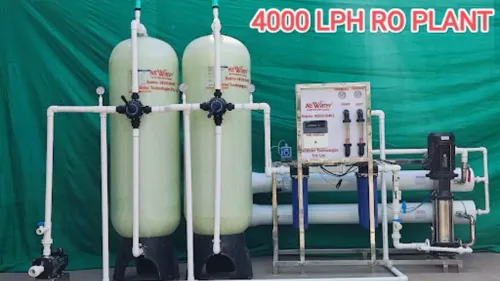
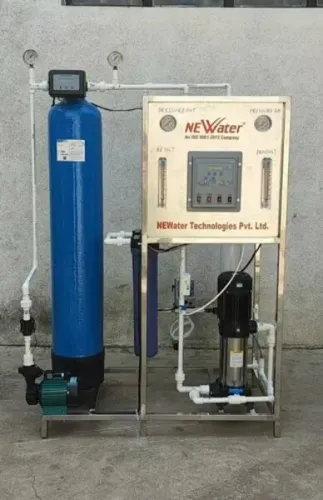
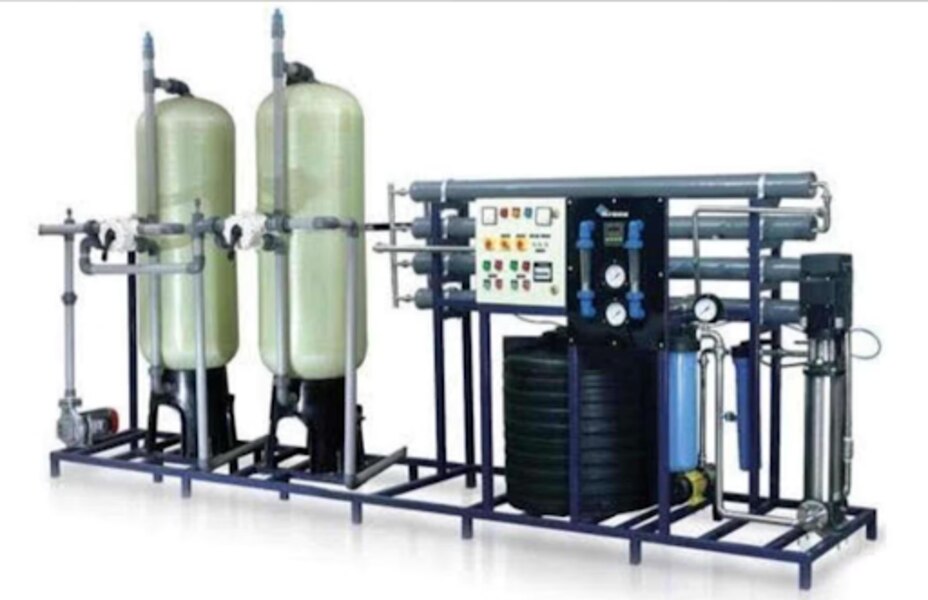
- The raw-water tank provides equalisation; the feed pump must deliver steady flow to a multimedia filter that removes suspended solids.
- Add chemical conditioning when hardness, iron, manganese, silica or alkalinity create scaling or fouling risk.
- An activated-carbon filter removes organics and chlorine, but confirm dechlorination with an analytical free-chlorine test. Carbon exhaustion can oxidise a polyamide membrane.
- Install a cartridge filter immediately before the high-pressure pump. It captures residual particles; it does not replace colloid, hardness, iron or manganese control.
| Feed result | Reliability risk | Design response |
|---|---|---|
| High TDS, hardness or silica | Osmotic pressure and scale reduce flow | Select pressure, recovery, antiscalant and membrane model from the analysis |
| Iron, manganese, turbidity, high SDI or microbiological load | Rapid fouling and rising pressure drop | Improve clarification or filtration and control biological growth |
| Free chlorine | Oxidises polyamide membrane | Provide dechlorination and verify residual chlorine at the array inlet |
| pH and temperature outside the membrane envelope | Changes salt passage, flux and material compatibility | Set dosing, temperature correction and operating limits |
Specify the high-pressure pump for actual TDS, temperature, recovery and flux—not catalogue capacity alone. Require feed and permeate SDI, pressure, flow and conductivity records to prove the design remains within limits.
Balance permeate production against concentrate and recovery limits
At 75% recovery, producing 10,000 LPH permeate requires about 13,333 LPH feed and leaves 3,333 LPH concentrate. Over continuous 24-hour operation, that reject-water volume reaches about 80,000 L/day. Confirm that “10,000 LPH” means permeate: if it means feed flow, product output at 75% recovery is only 7,500 LPH.
Do not increase recovery to reduce water consumption without checking the concentrate chemistry. As water leaves the membrane, dissolved salts become more concentrated, raising the risk of calcium carbonate scaling, sulfate scaling, silica scaling and metal-hydroxide deposits.
Set the recovery limit and select the antiscalant from a complete feed-water analysis, including hardness, alkalinity, sulfate, silica, temperature and pH.
Include a written route for the concentrate before approving the plant:
- Concentrate reuse: send it to cooling-tower make-up, washing or another process only after checking salt buildup and compatibility.
- Discharge: obtain permission and verify that the stream meets the receiving sewer or environmental limit.
- Evaporation: use a lined pond or mechanical evaporator where climate, land and regulations support it.
- Further concentration: reduce liquid volume with an evaporator or concentrator, then manage the remaining brine or solids.
A drain connection is not a disposal design. Measure the actual concentrate flow and test its composition during operation, because recovery changes alter both reject-water volume and scaling risk.
Match permeate quality to the industrial process
Single-pass RO is enough when the permeate-quality targets allow the remaining dissolved salts and the water will be used for general process water, cooling towers or rinsing water. Confirm the required conductivity and salt passage with the equipment or process owner; low TDS alone does not prove suitability.
1. Define the limit that matters at the point of use. Food processing may require controlled conductivity, taste, odour and microbiological control, while boiler feed demands tighter limits for hardness, silica and conductivity. Test the actual permeate, not just the feed and the manufacturer’s rejection percentage.
2. Add treatment when a contaminant remains important despite low bulk conductivity. Boron, silica, ammonia and some low-molecular-weight organics can pass through a single membrane stage. Two-pass RO reduces ionic load further; mixed-bed deionisation or electrodeionisation supplies very low conductivity water when boiler feed or another critical process requires it.
3. Treat microbial risk separately from dissolved salts. Ultraviolet treatment can support microbiological control after RO, but it does not remove minerals or replace sanitary storage and distribution practices.
If the water is for drinking, evaluate potable-water compliance, materials, disinfection and local rules separately; NSF/ANSI 58 addresses drinking-water RO treatment systems, not every industrial skid or application.
Specify controls, performance checks and site support before purchase
Require a purchase specification that defines 10,000 LPH as permeate flow, design temperature, recovery, feed pressure and guaranteed product-water quality. It must also state the operating plan, alarm responses, spare parts and commissioning tests.
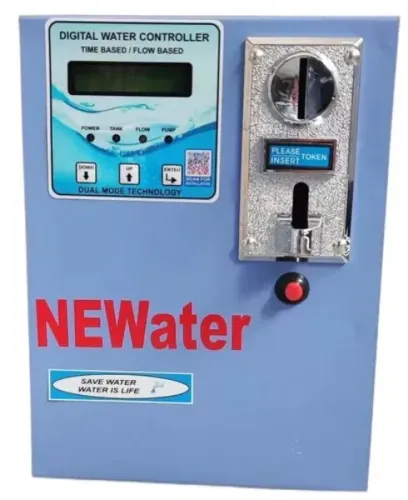
1. Specify protection logic: a low-pressure switch for inadequate feed, a high-pressure switch for blocked flow, a low-level interlock to prevent tank or pump dry running, feed-flow monitoring, conductivity monitoring and automatic shutdown. These safeguards protect pumps and membranes, but do not replace pretreatment checks or periodic laboratory analysis.
2. Require a baseline test at stable operating conditions and monthly trending of normalized permeate flow, normalized salt passage and pressure drop across the array. Define membrane cleaning triggers before capacity collapses: a 10% flow decline, a 5–10% salt-passage increase, or a 15% pressure-drop increase. Record temperature, recovery, pressure and conductivity with every reading.
3. Make the supplier document compatibility for the FRP pressure vessel and every wetted component. Check pump metallurgy, elastomers, valves, piping, cartridge housings and chemical-dosing parts against chlorine, acids, antiscalant, cleaning chemicals, temperature and pressure.
4. Put site support in the order: installation drawings, electrical and drain requirements, operator training, commissioning, acceptance sampling and response times for service. NEWater Technologies Pvt Ltd should provide a handover pack that identifies membrane elements, instruments, setpoints, cleaning chemicals and calibration intervals, so operators can act on an alarm rather than guess.
Related product
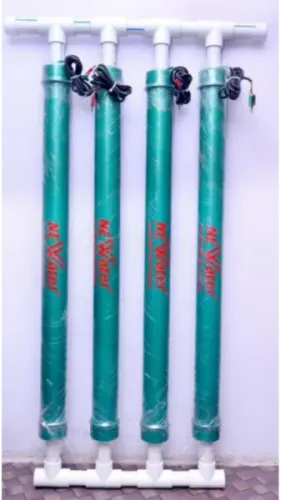
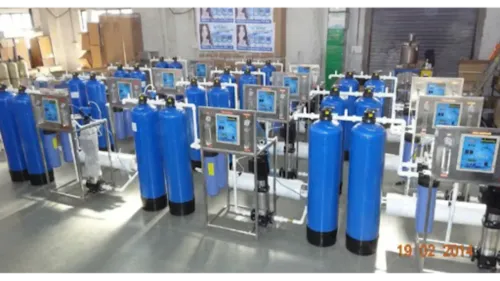
 | FRP RO PLANTS Introducing the FRP RO Plant by Newater India, a cutting-edge water treatment solution for clean and purified water. View product → |
Frequently asked questions
How much water does a 10,000 LPH RO plant produce daily?
At its rated permeate flow, it produces 80,000 litres in 8 hours, 160,000 litres in 16 hours and 240,000 litres in 24 hours. Allow for cleaning, flushing, downtime and operating losses.
What should determine the treatment train for a 10,000 LPH FRP RO plant?
Base it on feed-water analysis, including hardness, turbidity, iron, manganese, silica, alkalinity, total dissolved solids and microbiological quality. Use the results to select pretreatment, dosing and membrane protection.
How do recovery and concentrate affect RO plant operation?
Higher recovery produces more permeate from each litre of feed but concentrates salts in the reject stream. Set recovery below the point where scaling, fouling, pressure or concentrate disposal becomes unacceptable.
How do you specify permeate quality for industrial use?
Define limits for conductivity, total dissolved solids, pH, hardness, silica and other process-specific contaminants. Compare those limits with the needs of boilers, cooling systems, rinsing lines or manufacturing equipment.
What should you check before buying a 10,000 LPH FRP RO plant?
Request the design feed-water analysis, guaranteed permeate flow and quality, recovery, power requirement, membrane details, cleaning procedure, instrumentation, performance-test method and site-support scope.